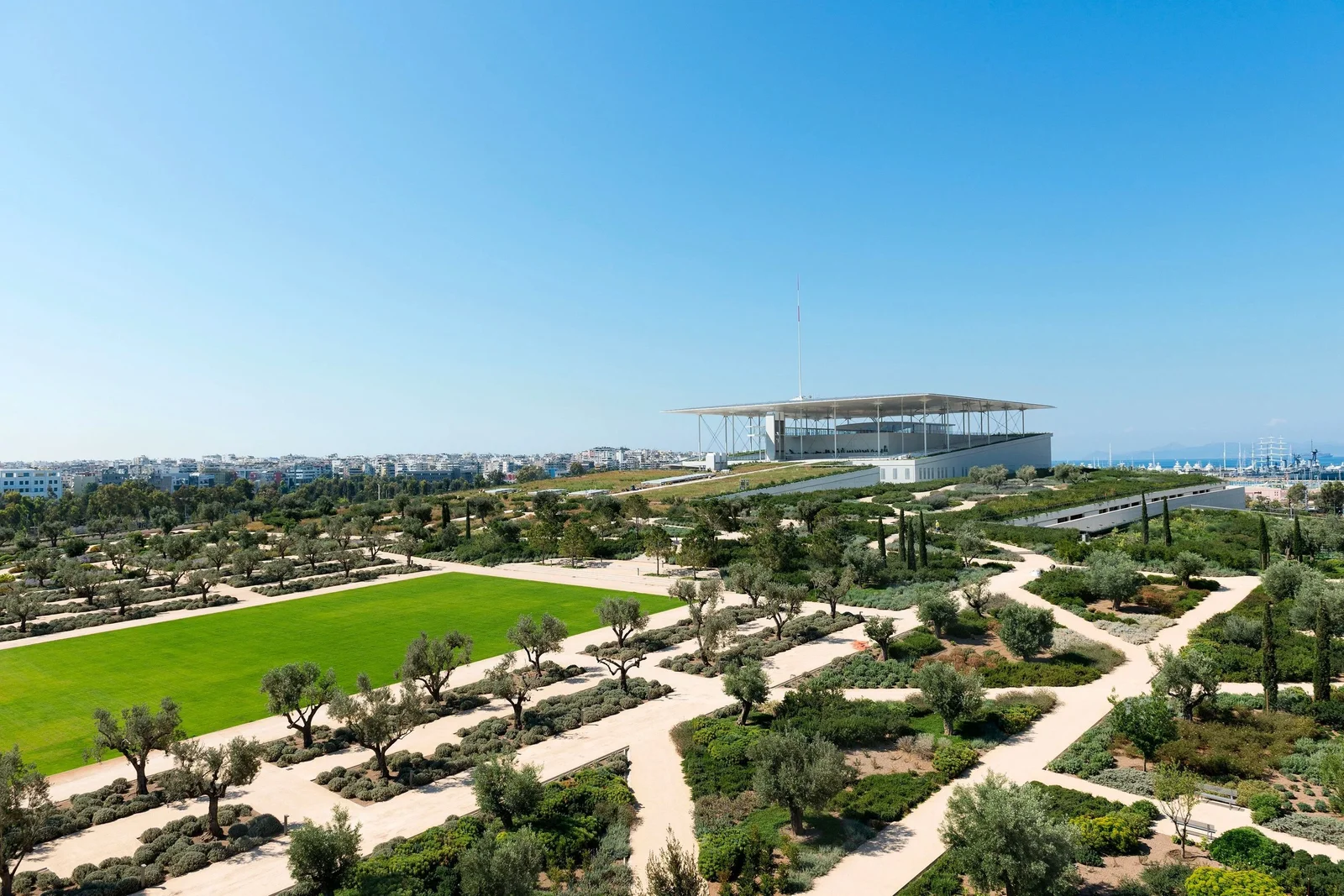
Quick answer: Kallithea is inner Athens’ coastal residential district, south of the centre, north of the Riviera, served by Metro Line 2 and the Athens coastal tram. It offers a middle path between central Athens liquidity and Riviera lifestyle pricing: typical asking bands €2,800 to 4,200 per square metre, no published district yield, so use the Athens city-wide average of 5.43%, and full inclusion in Attica’s €800,000 Golden Visa zone with the 120m² single-property rule. Tenant demand comes from metro commuters, hospital-sector workers, and professionals seeking coastal access without Glyfada price tags.
Quick answer: Kallithea is an inner-Athens district organised around Syngrou Avenue, with two universities, the hospital corridor, an office spine and the Stavros Niarchos Foundation park along or beside it. That combination produces something most Attica districts do not: a dense, year-round tenant who does not own a car. Since a Golden Visa asset may only be let on twelve-month residential terms, a district built around exactly that tenant is worth more to a permit holder than the yield table suggests.
Kallithea is Attica, so the threshold is €800,000 with 120 square metres of certified main usable area. At Kallithea prices that buys a great deal of floor space, which moves the whole question to what is actually scarce here.
Syngrou Avenue is the district’s economy, not its edge
Most residential districts are defined by what they are near. Kallithea is defined by what runs through it. Syngrou is one of the main arteries between central Athens and the coast, and the institutions along and beside it, Panteion University, the University of West Attica campus, the hospital cluster, the office buildings, and the Niarchos cultural centre and park, are employers and enrolments rather than amenities.
That gives the district a tenant profile with three useful properties for a long-let owner:
- It renews annually. Student and junior-staff tenancies turn over on a predictable cycle rather than unpredictably.
- It does not depend on tourism. The short-term-rental ban on a qualifying deed removes nothing this district was built on.
- It is not seasonal. February demand looks like October demand, which is not true of any coastal page in this collection.
In a grid this dense, parking is the premium
Kallithea sits in one of the tightest street grids in Attica. Buildings run to the plot line, streets are narrow, and off-street parking is genuinely scarce rather than merely desirable.
For a buyer this reorders the usual checklist. Aspect and quiet matter more than floor level; an interior courtyard orientation can be worth more in rent than a higher floor on the avenue, because Syngrou is loud and continuous. A parking space attached to the title is a real and transferable asset, and one of the few features in this district that reliably shortens a void.
Note that a parking space is not countable toward the 120 square metres of κύρια χρήση, however much it adds to the rent. The same is true of storage. On stock where the marketed area includes both, the certified enclosed figure can come back materially lower than the listing, which the 120 m² rule sets out in full.
What €800,000 does at inner-Athens prices
Kallithea’s entry per square metre is well below the Riviera and below prime central districts, so the Attica threshold buys size comfortably. The practical effect is that a Golden Visa buyer here is not hunting for a unit large enough to qualify; they are deciding what to do with the surplus.
Three shapes that surplus usually takes, and what each does to the permit:
| Approach | Works for a Golden Visa file? | Note |
|---|---|---|
| One large apartment on a single deed | Yes | The straightforward route; certify the enclosed area |
| Two smaller apartments in the same building | No | The rule is one property on one title; areas cannot be added |
| A large unit plus a separate parking title | Only on the residential title | The parking deed is a second property and counts for nothing |
The second row is the common error in low-€/m² districts and it is worth stating plainly: buying two €400,000 flats in Kallithea does not produce a Golden Visa. It produces two flats.
Older stock, and what an engineer will and will not certify
Much of Kallithea’s building stock dates from the 1960s to the 1980s. That is where the value is and it is also where the paperwork risk sits: enclosed verandas, converted semi-basements, added rooftop rooms and internal reconfigurations that never reached a permit.
For an ordinary buyer those are negotiating points. For a Golden Visa buyer they are eligibility items, because an un-legalised alteration is not counted toward main usable area and can complicate the title altogether. Ask for the Electronic Building Identity and the engineer’s certificate before the preliminary agreement, and treat any discrepancy between the listing area and the certified area as the real number.
Two universities set this district’s letting calendar
Kallithea houses Panteion University and Harokopio University, and that is the single most useful fact about its rental market. It gives the district a tenant class that most inner-Athens grids do not have in the same concentration: students, postgraduates and junior academic staff, arriving on an academic calendar rather than a commercial one.
For an owner, the calendar is the practical consequence. Demand concentrates sharply in September and early October, thins through the winter, and empties in July and August when the teaching year has ended. A unit that is empty in June is not necessarily a unit with a problem; it is a unit that missed the letting window and will wait for the next one. That argues for scheduling refurbishment and tenant turnover around the academic year instead of around the owner’s convenience, and for accepting that a vacancy arising in spring costs more months than the same vacancy arising in August.
It also shapes what lets easily. Student and junior-academic demand is for smaller units, close to a tram or bus route into the university, furnished, and priced against a budget that is set by a family or a stipend rather than by a salary. A large, well-specified three-bedroom apartment in Kallithea is competing for a different and much thinner tenant pool than a compact one-bedroom on the same street. The building with more small units is generally the easier building to keep occupied.
For a Golden Visa buyer, this cuts against the district in a specific way that is worth naming. The qualifying asset has to clear €800,000 on one deed and certify 120 square metres, which puts you at the large-unit end of Kallithea’s stock. That is precisely the end where the district’s characteristic tenant demand is weakest. The student pool cannot afford the qualifying unit, and the tenant who can afford it has more reasons to live elsewhere. It is a solvable problem, but it should be solved before purchase, by identifying who specifically will rent the large apartment you are buying rather than assuming Kallithea’s general letting strength transfers to it.
One further consequence of the academic base is worth planning for: the district’s letting market is served by agents who work the student cycle and know which blocks fill first. That local knowledge is worth more here than a general Athens brief.
A non-qualifying purchase faces none of this. A smaller Kallithea unit bought outside the Golden Visa sits directly in the district’s strongest demand, and the rental income guide sets out how the income is taxed either way.
Where Kallithea sits against its neighbours
Against Piraeus at the same tier: both are dense, both let year-round, and the difference is the employer. Piraeus tenants work around a harbour whose operations shape the street; Kallithea tenants work in institutions that do not care which way the window faces.
Against the Riviera: Glyfada costs two to three times as much per square metre and buys amenity, sea access and capital position. Kallithea buys floor area and a tenant. For a permit holder who will not live in the property, the second is the more useful purchase, and it is the reason inner-Athens districts outperform the Riviera on net yield despite the postcode.
Advantages and disadvantages of buying in a dense inner grid
| Advantages | Disadvantages |
|---|---|
| The lowest entry per square metre of any Attica market on this site | Syngrou is loud and continuous, and orientation matters more than floor |
| A year-round tenant from institutions rather than tourism | Parking is genuinely scarce and adds materially to price |
| The short-term letting ban removes an income the district never had | 1960s to 1980s stock carries a high incidence of unpermitted alteration |
| €800,000 clears 120 m² with substantial headroom | Thin comparables at that price, because local stock transacts far below it |
Risks and what to check before committing
The eligibility risk here is documentary rather than financial. Ask for the Electronic Building Identity and the engineer’s certificate before the preliminary agreement, and treat the certified enclosed figure as the real area regardless of the listing. Confirm any parking or storage sits on the same title or understand that it counts for nothing toward the 120 m². And read the building’s own regulation, because in a dense grid the shared costs and the rules on alteration matter more than in a low-density suburb.
What the acquisition costs, and what the tax does to the rent
An Attica deed at €800,000 carries transfer tax of about €24,720 at 3.09%, notary and registration at 1.5% to 2.0%, legal fees from €2,500, and engineer certification of €800 to €1,500. Golden Visa state fees add €2,000 for the main applicant, €150 per adult family member and €16 per card, which puts the all-in figure near €856,000 to €880,000.
The tax on the income matters more here than in most districts, because Kallithea’s case rests on rent. Greek rental income is taxed on gross rent rather than on profit, with only a flat 5% repairs allowance set against it: 15% on the first €12,000, 25% from €12,001 to €24,000, 35% from €24,001 to €35,000 and 45% above that. A unit letting for €18,000 a year therefore pays 15% on the first €12,000 and 25% on the balance, before ENFIA, management, vacancy or maintenance are counted at all.
Next steps: the other dense year-round Attica market · why two small flats do not make one Golden Visa.
Frequently Asked Questions
Kallithea suits investors wanting inner-Athens coastal exposure with metro and tram connectivity between the centre and the Riviera. No district yield is published for Kallithea; the Athens city-wide average is 5.43%. The municipality is inside Attica's €800,000 Golden Visa zone with the 120m² minimum.
Kallithea is a coastal municipality south of central Athens, bordering Neos Kosmos and Palaio Faliro. Metro Line 2 and the coastal tram serve the district, linking it to the centre and southern beach suburbs.
Asking prices typically span €2,800 to 4,200 per square metre. At €3,400 per square metre, €800,000 buys approximately 235 square metres, comfortably above the Golden Visa 120m² threshold.
Yes. Kallithea is within Attica's prime zone under Law 5100/2024. The minimum is €800,000 in a single property of at least 120 square metres. Short-term tourist rentals on the qualifying asset are prohibited.
No district yield is published for Kallithea; the Athens city-wide average is 5.43%. Net yields after tax and costs land roughly 1.0 to 1.5 points below gross.
Kallithea offers lower entry per square metre, higher gross yield than most Riviera addresses, and faster metro access to central Athens. The trade-off is less prestige branding and older average building stock.
Syngrou Avenue traffic noise, older building stock with renovation costs, title and illegal-extension issues, tram noise on lower floors, and Golden Visa STR restrictions. Verify moratorium boundaries if planning STR on a non-GV asset.
Kallithea in one paragraph
Kallithea is Attica’s middle-ring coastal district: metro-linked to central Athens, tram-connected to the southern coast, and priced well below the Riviera postcodes it borders. For Golden Visa buyers that combination matters, because Kallithea sits inside the €800,000 Attica prime tier under Law 5100/2024 while offering stock that still clears the 120 m² usable-area test on a single deed. The trade-off is honest: you pay the Attica threshold without paying Glyfada or Voula prices, and you accept a tenant profile driven by commuters and students rather than by seasonal demand. Long-term letting is the only option on the qualifying asset, so underwrite twelve-month leases, not summer nightly rates.
Read next
Athens Golden Visa €800K: Which Areas Qualify in 2026
Athens €800K Golden Visa zone: Piraeus, Glyfada, Voula, Vouliagmeni, Ellinikon. Prices, 120m² rule and area guide for 2026.
Property for Sale in Athens: Prices by District, 2026
Kolonaki asks about €5,409 per m² and Patisia €1,731, a threefold spread inside one city. Where the Riviera sits, and why Athens yields beat the islands.
Greece Property Investment Guide 2026: Yields & Data
Greece property investment 2026: 41,743 transfers worth €4.2B, +7.5% price growth, Athens yields to 5.43%, Golden Visa tiers and the Ellinikon regen.
Due Diligence Greece Property: The Complete 2026 Checklist
Due diligence Greece property: title search, cadastre, ENFIA arrears, permits, engineer survey, co-ownership, mortgages, Golden Visa tier. Full checklist.
Greece Rental Yields 2026: Real Net Numbers by City
Measured Greek yields by city and unit size, what short lets really earn, and what survives tax, management and vacancy.
Athens Airbnb Moratorium 2026: Zones, Rules and Impact
Athens STR moratorium through end-2026: density caps in Kolonaki, Koukaki and centre. Separate from the Golden Visa rental ban, rules explained.
Get your Greece property shortlist
Share your budget, region (Athens, Crete, islands, or Peloponnese), and Golden Visa goal. We reply within one business day with matched options and next steps.