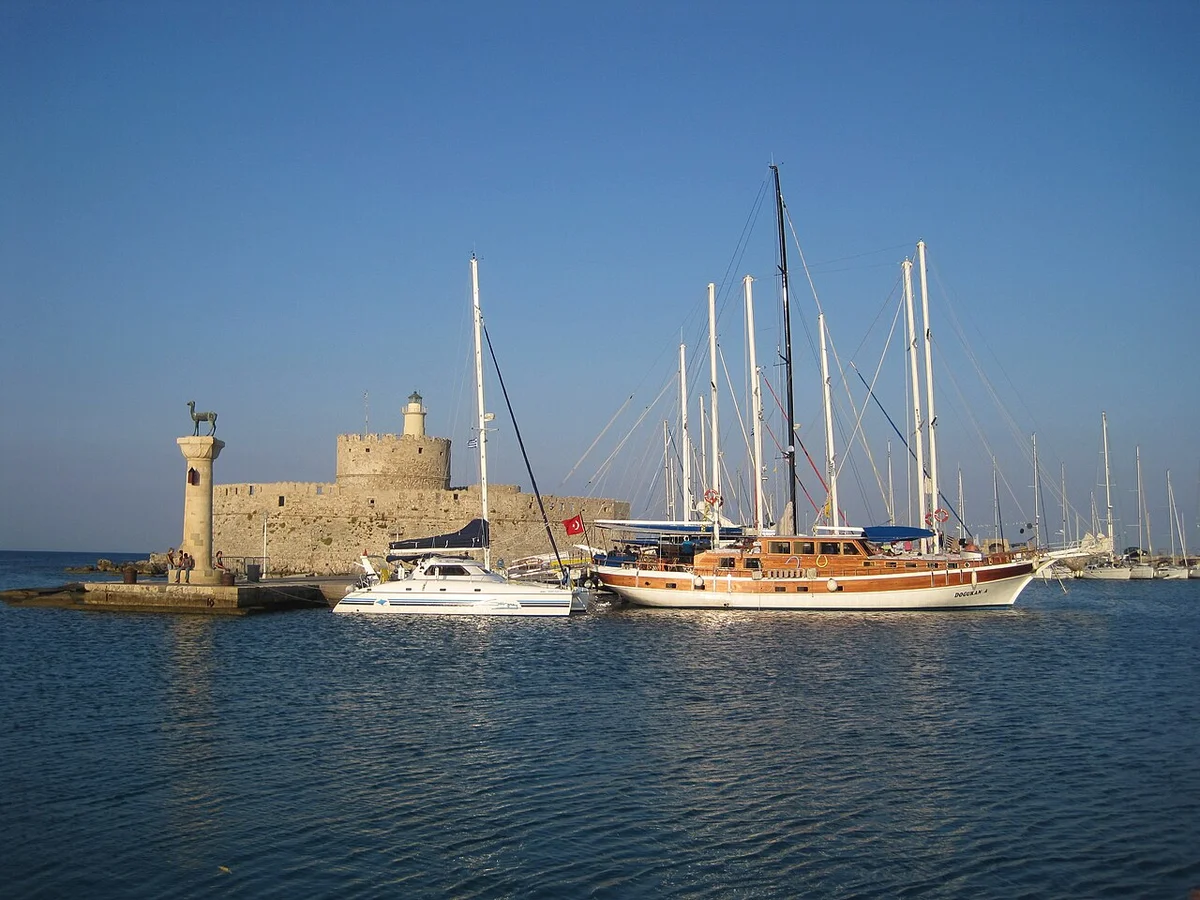
Quick answer: Rhodes qualifies at the €400,000 Golden Visa tier and the threshold buys plenty of space: €1,900 to €2,800 per square metre puts 143 to 200 square metres within reach, so the 120 m² certified-area test is comfortable here in a way it is not on Mykonos or Santorini. The constraint that defines Rhodes is legal rather than financial: it is a Dodecanese border-zone island, so a non-EU buyer needs Ministry of National Defence clearance before the deed can complete at all.
That approval is not a formality to be handled during conveyancing. It is a gate in front of the conveyancing, and the single most common planning error on Rhodes is starting it after the preliminary agreement instead of before.
The border-zone rule, and who it actually applies to
Greece restricts acquisition by non-EU nationals in designated border areas under Law 1892/1990. The designated set includes the Dodecanese, Rhodes, Kos, Leros, Patmos, Kalymnos, Symi, Tilos, Nisyros, Astypalaia, Karpathos, Kasos and Halki, along with the Eastern Aegean islands, northern mainland units bordering Turkey, Bulgaria, North Macedonia and Albania, and Corfu and Paxos in the north Ionian.
| Buyer | Rhodes | Athens, Crete, the Cyclades |
|---|---|---|
| EU or EEA national | No restriction | No restriction |
| Non-EU national | Defence Ministry approval required before the deed | No restriction |
The practical shape of it: an application is filed with the relevant committee, a decision follows in roughly two to six months, and no notary will authenticate the transfer until it is in hand. Budget €500 to €1,500 for the additional legal work, and treat the elapsed time as the first line of the project plan rather than a contingency. The border zones guide lists the designated areas in full.
Sequencing matters more than cost here. A buyer who signs a preliminary agreement with a completion deadline, then discovers the clearance timetable, has bought a deadline they cannot meet.
What a €400,000 Rhodes purchase actually costs
The threshold is the qualifying investment, not the capital required, and on Rhodes the gap between the two contains one line that is not a fee at all but a wait.
| Line | On a €400,000 deed | Note |
|---|---|---|
| Transfer tax (ΦΜΑ) | ~€12,360 | 3.09% of the taxable value, often below market price |
| Notary | €4,800 to €5,952 | Regulated tariff |
| Lawyer | €4,000 to €6,000 | Title chain and the 120 m² verification |
| Land registry | €1,900 to €2,600 | Fixed element plus a variable one |
| Engineer, translation, administration | €800 to €1,500 | Higher on island stock than mainland resale |
| Agent commission, where one acts | 2% to 2.5% plus 24% VAT | Not always present on private sales |
| Ministry of National Defence clearance | €500 to €1,500 | Border-zone legal work, non-EU buyers only |
| Golden Visa fees | €2,000 main applicant, €150 per adult family member, €16 per card | State fees, separate from the purchase |
A €400,000 deed lands between €430,000 and €440,000 all in, and a non-EU family of four clears €445,000 once permit fees are counted. Line-item detail for the rest sits in the cost of buying property in Greece guide.
Where the money goes on the island
Rhodes is large enough to have genuinely distinct submarkets rather than one price with variations.
| Segment | Indicative €/m² | Typical product | €400,000 implied size |
|---|---|---|---|
| North coast secondary street | €1,600 to €1,900 | 1990s apartment, partial renovation | 210 to 250 m² |
| Ixia and Ialysos coastal road | €2,000 to €2,400 | Renovated three-bed with parking | 167 to 200 m² |
| Rhodes town suburbs and Kallithea | €2,200 to €2,600 | New-build or full retrofit | 154 to 182 m² |
| Old town renovated townhouse | €2,600 to €3,200 | Heritage character, limited supply | 125 to 154 m² |
| Lindos village premium | €3,000+ | Small luxury stock | Often tight at €400,000 |
At €2,000 per square metre, a fair planning midpoint for quality north-coast stock: €400,000 buys around 200 square metres, comfortably above the minimum. That headroom is Rhodes’s real advantage over the premium Cyclades: it lets a buyer choose layout, parking and storage rather than scraping the statutory floor. Only the old town and Lindos push the size test into play.
The tenant is real here, which is not true of every island
Rhodes has a year-round population, a working town, a university presence and a hospital, so the twelve-month residential lease that a Golden Visa deed is limited to actually has somebody to sign it. Long-let gross yields run about 3.5% to 5.0% on well-located stock, below working-class Athens, above the premium Cyclades, and achievable rather than theoretical.
Short-term tourist letting of the qualifying property remains prohibited nationwide for the life of the permit, so the 8% to 10% figures quoted anecdotally for Faliraki holiday stock belong to non-qualifying property and must not be used to underwrite a Golden Visa file.
Seasonality still shows up in vacancy rather than in rent: coastal tenants often work on tourism-sector cycles, so budget turnover between tenancies on north-coast stock more generously than an Athens model would.
Title on Rhodes has a different history from the mainland
The Dodecanese passed through Italian administration before joining Greece in 1947, and the islands carry land-registration arrangements inherited from that period alongside the national cadastre programme. For a buyer the practical consequence is not that title is worse but that the paper trail can be older and in more than one system, so a full ownership-chain search by a local lawyer is worth more here than a cadastre extract alone.
Combine that with the standard island checks, aigialos setback near the water, Ephorate clearance, forest-map status on hillside plots, and a Rhodes file is simply longer than an Athens one. It is not riskier if it is run properly; it takes more calendar.
Inside the walls, the Archaeological Service is a party to your renovation
Rhodes Old Town is a UNESCO World Heritage site and an inhabited medieval city at the same time, and the combination produces a category of Greek property that behaves like nothing else on the island. People live in it, houses change hands in it, and every intervention in the fabric of a listed building inside the walls runs through heritage consent rather than through the ordinary planning route.
What that means in practice is a second authority with its own timetable sitting between you and any work. Facades, openings, roofs, materials and often interior elements are controlled. Services that are routine elsewhere, rewiring, replumbing, insulation, air conditioning, anything that involves cutting into historic fabric, become design questions requiring approval before they become building work. Approvals are obtainable and they are not quick, and a contractor’s programme that does not budget for them is a programme that will slip.
Practical living conditions inside the walls follow from the same constraints. Vehicle access is restricted across much of the medieval town, parking is outside it, and deliveries and refuse collection work on terms set by the street rather than by the household.
The corollary is that a cheap price inside the walls is frequently a correct price. A house needing comprehensive work in a controlled environment carries an unknown and consent-dependent renovation cost, and the discount is the market pricing that uncertainty rather than an oversight you have spotted first.
For a Golden Visa buyer specifically, the Old Town is a difficult place to satisfy the rules even before heritage consent enters. Medieval houses were not built to modern registration conventions: floor areas are irregular, structures have been subdivided and recombined over centuries, ownership can sit across more than one title, and certifying 120 square metres of enclosed main usable area on a single deed is frequently impossible on stock that is otherwise attractive. Add the border-zone clearance this page has already described, and the number of Old Town houses that satisfy every condition at once is small.
Insurance is harder to place on medieval fabric than on modern stock, and quotes come with conditions about maintenance and materials that are worth reading before exchange rather than at renewal.
Buildings inside the walls also share party walls, roofs and drainage with neighbours in ways that modern construction does not, so a defect next door can become your defect, and the repair needs two owners and one consent before it can start.
Seasonality separates the two markets as well as consent does. The Old Town’s economy is almost entirely visitor-driven and much of it closes out of season, while the modern town holds a resident population, public administration and a university presence that keep it working year-round. Only one of those supports the twelve-month tenancy a qualifying asset is limited to, and it is not the medieval one.
None of that applies to the modern town, to Ialysos and Faliraki, or to the villa stock outside the built-up areas, which is where most qualifying purchases on this island actually happen. The distinction is worth drawing sharply, because “Rhodes” in a listing covers two markets with almost nothing in common beyond an island. Establish which one a property is in before anything else, and the due diligence guide covers the title checks that follow.
Who Rhodes suits
An EU buyer looking for maximum certified square metres at the €400,000 tier with a genuine year-round tenant, or a non-EU buyer who understands that the Defence Ministry step comes first and plans a fifteen-to-twenty-four-month journey from decision to residence card.
It suits badly anyone in a hurry. A non-EU buyer who needs a permit quickly should compare a mainland €400,000 market with no border-zone step, the Peloponnese guide covers the closest equivalent, and should read the realistic Golden Visa timeline before assuming any island can be fast.
Risks specific to a border-zone island, and the order to clear them
Rhodes is not a risky market. It is a sequenced one, and the cost of getting the sequence wrong is measured in months rather than in euros.
| Step | Typical duration | What it blocks if skipped |
|---|---|---|
| Ministry of National Defence clearance (non-EU only) | 2 to 6 months | The notary cannot authenticate the deed at all |
| Full ownership-chain search | 3 to 6 weeks | Dodecanese title can sit across two registration systems |
| Engineer’s certificate on enclosed area | 1 to 3 weeks | The 120 m² test, which cannot be fixed later |
| Forest-map and aigialos checks on plots | 4 to 12 weeks | Coastal and hillside sites specifically |
| Golden Visa file after the deed | 12 to 18 months | The permit itself |
Buyer scenarios that fit Rhodes
An EU national buying at €400,000 for maximum certified area and a genuine year-round tenant is the best-matched profile, because the clearance step does not apply and the size headroom is generous. A non-EU buyer with an eighteen-to-twenty-four month horizon fits equally well provided the Defence application is filed before the preliminary agreement rather than after it. A buyer who needs a permit inside a year does not fit this island at all and should look at a mainland €400,000 market.
Next steps: which areas of Greece are designated border zones · a €400,000 mainland market with no clearance step.
Frequently Asked Questions
Yes. Rhodes sits outside Greece's four high-demand zones under Law 5100/2024. The minimum qualifying investment is €400,000 in a single residential property with at least 120 square metres of usable area. Mykonos and Santorini are the only islands on the €800,000 tier.
No. A property registered as the qualifying Golden Visa asset cannot hold a GNTO short-term rental licence for the full permit period. Long-term residential leases of twelve months or more are permitted. Personal holiday use is also allowed.
Quality apartments in Rhodes town and the northern coastal belt (Ixia, Ialysos, Kalithea) typically trade at roughly €1,900 to 2,800 per square metre. UNESCO-listed old-town stock runs higher on scarce supply. Secondary villages and 1990s blocks can start near €1,600 per square metre.
Long-term residential gross yields on Rhodes typically run 3.5 to 5.0% on well-located coastal stock, with net yields near 1.8 to 3.0% after ENFIA, management, vacancy and Greek income tax. Golden Visa buyers must underwrite on LTR income, not tourist-platform assumptions.
Rhodes has one of the deepest island resale markets in Greece: year-round airport connectivity, a large British and Northern European second-home base, and established agent networks in Rhodes town and the north-coast corridor. Liquidity is stronger than on smaller Dodecanese islands but thinner than Athens.
At an indicative €2,000 per square metre on the north-coast belt, €400,000 buys roughly 200 square metres of usable area. Old-town renovated stock at €2,800 per square metre yields about 143 square metres. Verify certified usable area on the engineer's certificate before exchange.
Both islands sit in the €400,000 tier. Crete offers larger urban economies in Heraklion and Chania; Rhodes offers stronger UK-oriented tourism branding and a UNESCO medieval old town. Rhodes north-coast pricing is broadly comparable to Chania's secondary districts on a per-square-metre basis.
Read next
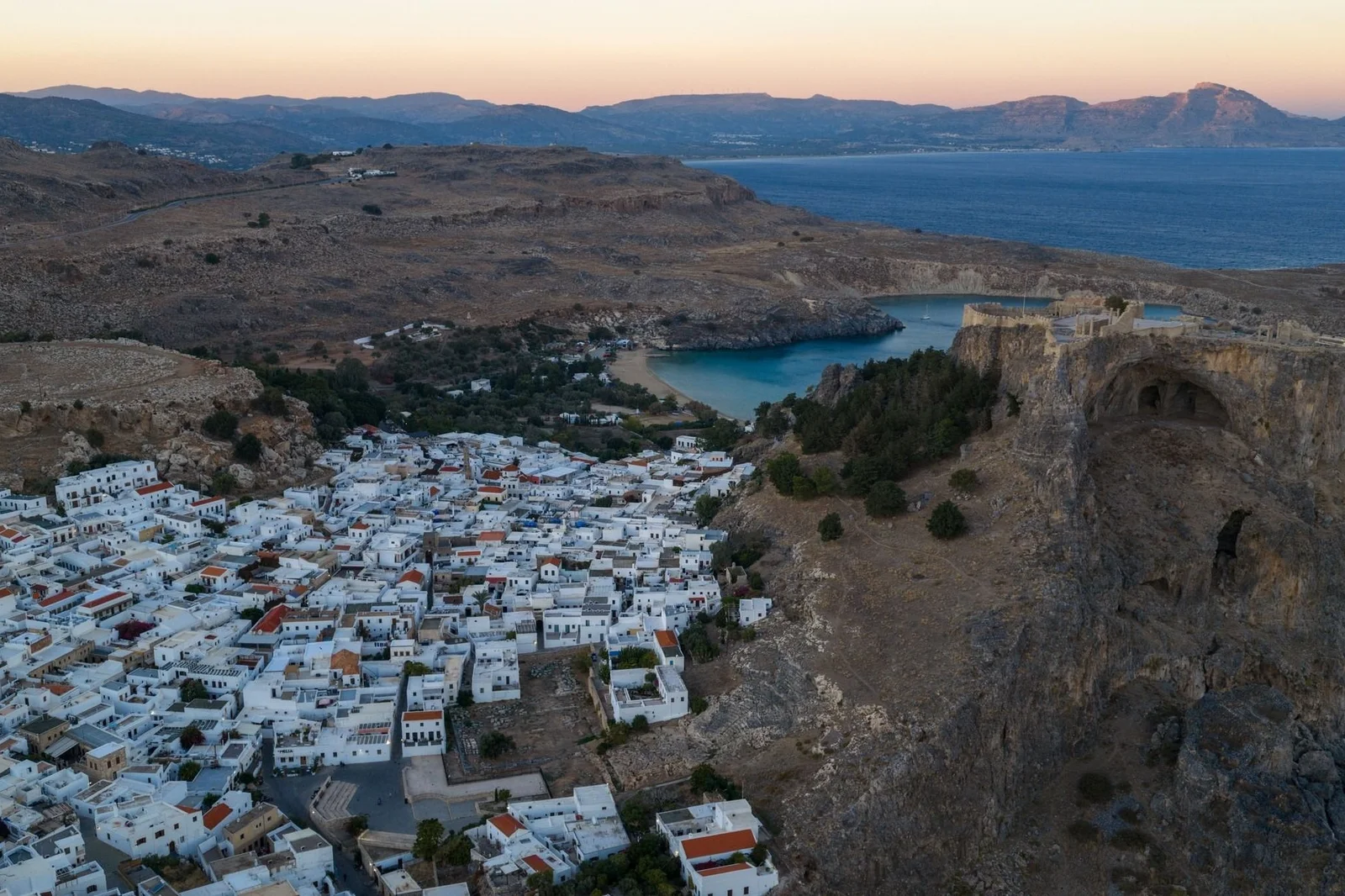
Property for Sale in Rhodes, Greece: Prices by Area 2026
Rhodes asks about €2,421 per m², up 22.40% in a year, from €1,453 in Archaggelos to €3,339 in Lindos. The island that keeps working after October.
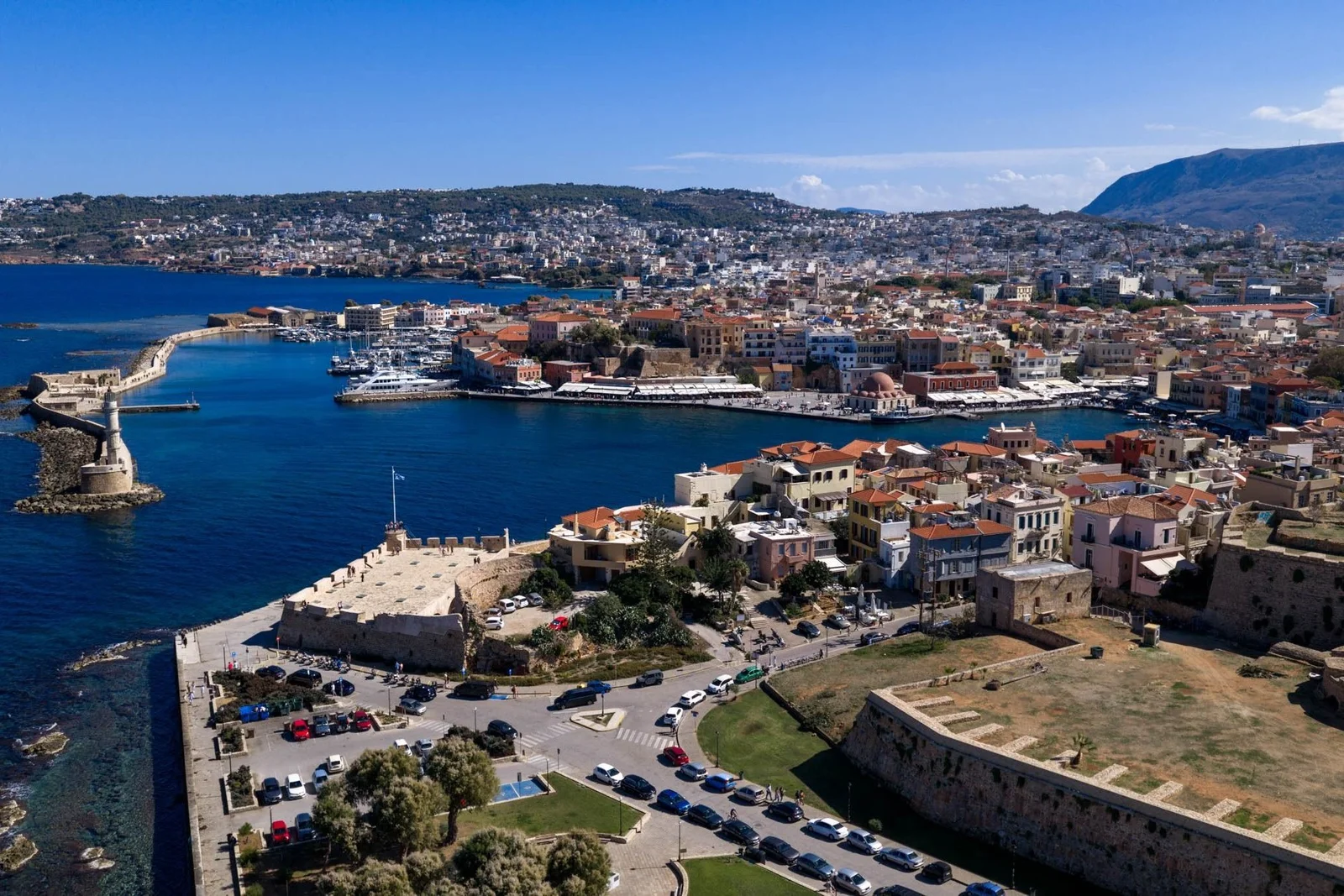
Crete Property Investment Guide 2026: Island Markets
Crete property investment 2026: €400K Golden Visa tier, ~€2,329/m² average, what the yield data supports, north coast markets, GV vs Attica arbitrage.
Greece Golden Visa Property Tiers 2026: €800K vs €400K
Law 5100/2024 created three Greece Golden Visa tiers. Compare €800K prime zones, €400K regional, and €250K conversion thresholds to pick the right investment.
Greece Rental Yields 2026: Real Net Numbers by City
Measured Greek yields by city and unit size, what short lets really earn, and what survives tax, management and vacancy.
Cost of Buying Property in Greece: Full 2026 Fee Guide
Full cost of buying property in Greece: FMA 3.09%, notary, lawyer, registry, agent, ENFIA. Worked examples at €250K, €400K and €800K.
Get your Greece property shortlist
Share your budget, region (Athens, Crete, islands, or Peloponnese), and Golden Visa goal. We reply within one business day with matched options and next steps.