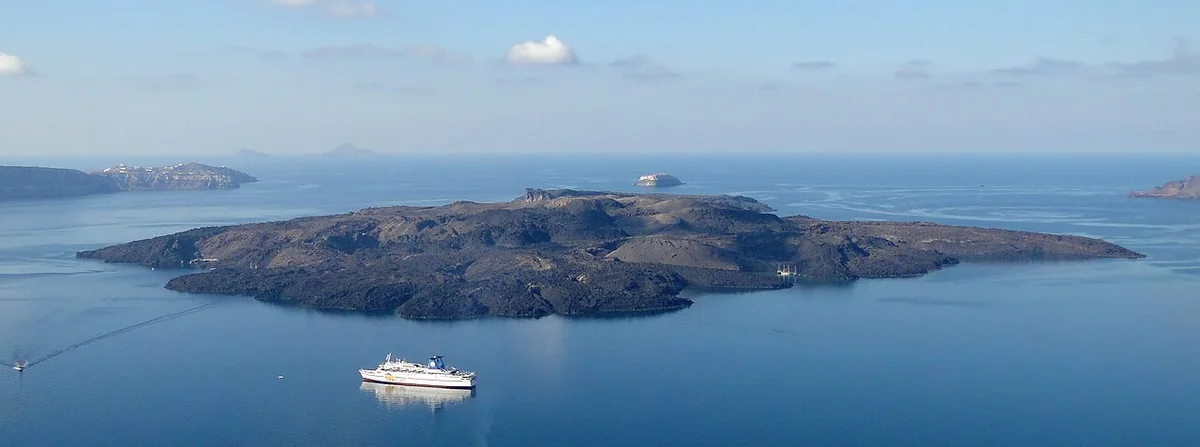
Quick answer: Santorini is an €800,000 Golden Visa market where the price test is trivially met and the 120 m² certified-area test is where files fail. At caldera-front rates of roughly €8,000 per square metre the threshold buys about 100 square metres, twenty short of the statutory minimum, while the same €800,000 clears the floor with room to spare in the island’s inland and non-caldera villages. The caldera premium and the residence permit are, at this budget, mutually exclusive.
That is the whole page in one line, and it is worth stating first because almost every other consideration on Santorini is downstream of it.
The premium you are paying for is the one the certificate refuses to count
Santorini’s price structure is unusual even by Greek island standards: value is concentrated along a few kilometres of caldera rim and falls away sharply behind it. A property’s worth here is largely a function of what it looks at.
The Golden Visa is indifferent to all of it. The statute asks for 120 square metres of main usable area, κύρια χρήση, recorded on the Electronic Building Identity, enclosed interior, with terraces, external stairs, storage and outdoor living excluded. On caldera stock those excluded elements are where the money went.
| Position | Indicative €/m² | What €800,000 buys | 120 m² test |
|---|---|---|---|
| Caldera front, Oia and Imerovigli | ~€8,000 | ~100 m² | Fails |
| Caldera-adjacent, set back | €5,000 to €6,500 | ~123 to 160 m² | Marginal to comfortable |
| Fira and the central spine | €4,000 to €5,000 | ~160 to 200 m² | Comfortable |
| Inland villages and the east coast | €2,500 to €3,500 | ~228 to 320 m² | Comfortable |
The table is the decision. A buyer who wants Oia and a permit at €800,000 is asking for two things the market cannot supply together; a buyer who will accept Pyrgos or Emporio gets both and change. The 120 m² rule sets out precisely which parts of a Cycladic house the engineer counts.
Cave houses are measured like any other building, and that is the point
Santorini’s yposkafa, houses cut back into the caldera pumice, are the island’s signature product and they attract a particular confusion: that because they are carved rather than built, their area is somehow indeterminate.
It is not. A yposkafo has a built façade with door and windows on the caldera side, its interior is enclosed, and a Greek engineer measures it conventionally against the Electronic Building Identity. What makes cave stock difficult for a Golden Visa file is not measurement ambiguity but arithmetic: these are small, expensive, deeply desirable interiors, and small interiors at €8,000 a square metre reach €800,000 long before they reach 120 square metres.
Two further characteristics matter at purchase and neither is about the permit. Vaulted and irregular ceiling heights affect how a space is used but not how it is certified. And excavation into pumice is tightly controlled, so extending a cave house to reach a threshold is not a plan a buyer should assume is available.
What the island’s water and season do to a holding cost
Santorini has no meaningful natural fresh water supply and runs on desalination and imported supply. For an owner that is a running-cost line rather than a headline, and it sits alongside the other costs of holding property on an island that empties in winter: seasonal maintenance access, freight for every repair, and higher insurance on exposed cliff positions. Those lines land on an asset that, at the €800,000 threshold, is already being bought at a price set by the view rather than by the floor area, and they are paid in full during the months the island produces nothing. A pool and a garden are the heaviest consumers of a water supply that arrives by desalination or by boat, so the properties that show best in photographs are the ones that cost most to keep standing. Model the holding cost across twelve months rather than across the season, because the bills do not observe the season.
None of that is a reason to avoid the island. It is a reason to underwrite the holding cost properly rather than modelling a mainland cost base against island prices, particularly on a Golden Visa asset where the hold will be measured in years rather than seasons.
The income the permit allows is the income the island does not generate
Short-term tourist letting of the qualifying deed is prohibited nationwide for the life of the permit. Santorini’s rental economy is almost entirely short-term, which leaves the twelve-month residential lease as the only compliant route, and long-let gross yields here run 2.5% to 4.0%, because caldera purchase prices reflect a global view market while long-term rents reflect what people who work on Santorini can pay. Run that against the threshold and the gap is stark: 3% gross on an €800,000 deed is €24,000 of annual rent, from which the Greek rental scale takes its share on gross rather than on profit, as the rental income guide sets out, and the water, freight, insurance and seasonal maintenance above come out of what is left.
The number a buyer should carry away is that the qualifying asset on this island is a capital and lifestyle position that happens to produce some income, not an income position. Anyone underwriting it on the nightly rates visible on booking sites in August is underwriting a use the permit forbids.
Buyers who want both the permit and seasonal income hold two properties: one qualifying asset on a twelve-month lease, and a separate non-qualifying property registered under ΑΜΑ for licensed short letting. That is the only compliant structure, and it doubles the capital rather than splitting it.
On the caldera face, access is the cost nobody quotes
A caldera property is built into a cliff, and the thing that follows from that is not a view, it is logistics. Many of the most desirable positions have no vehicle access at all. What reaches them arrives on foot down a stepped path, on an animal, or by a private lift or funicular installed for the purpose, and everything that has to leave, rubble, old fittings, waste, travels the same way in reverse.
That single fact reprices every piece of work the building will ever need. A bathroom refit that is a routine job in Fira town becomes a job where each bag of materials is carried down and each bag of debris carried up, and the labour to do the carrying is charged at island rates in a season when every trade is already committed. Renovation quotes on caldera stock are not high because contractors are opportunistic; they are high because the access is genuinely the work.
Three consequences for a buyer. First, budget maintenance as a multiple of what the same building would cost in an accessible position, not as a percentage of value. Second, establish exactly how the property is reached and what that route legally is: a stepped path crossing a neighbour’s land is an easement question, and a private lift is a machine with an owner, a service contract and a replacement cost that somebody is liable for. Third, ask what happens when the lift fails in August, because on a cliff face with no road, that is not an inconvenience, it is a property that cannot be used or serviced until it is fixed.
Deliveries and refuse follow the same route as everything else. A household on the caldera face carries its shopping down and its rubbish up, or pays somebody to, and that arrangement is worth confirming rather than assuming.
Establish what the terrace actually is, in title terms, before valuing it. Outdoor space on the caldera is the asset, and on subdivided older houses a terrace can be shared, subject to a right of way to a neighbour, or built over a structure belonging to somebody else.
Neighbouring construction is worth a question too. The caldera face is densely built and terraced, so work on the property above yours happens directly over your roof and terrace, with the same access constraints, and it can occupy the view and the outdoor space for a season.
The structure itself deserves the same scepticism. These are buildings cut into and built onto volcanic material on a steep face, frequently extended over generations, and the questions an engineer should be answering are about the retaining structure, the drainage, and how water moving through the cliff behaves around the building. That is a different survey from the one an Athens apartment needs, and the engineer you instruct should have done it on this island before.
Insurance follows the same logic and should be quoted before exchange rather than after. Cover on a cliff-face building in a seismic zone is neither automatic nor uniformly priced, and an insurer’s questions about the retaining structure are a useful second opinion on the engineer’s.
None of this argues against buying on the caldera. It argues for pricing the access into the offer rather than discovering it after the deed, and for treating any quote produced without a site visit as a placeholder.
Due diligence items specific to a caldera purchase
- Geotechnical stability. Caldera-rim positions sit on pumice and past landslip is a documented risk in specific locations. A geotechnical opinion is not an optional extra here.
- Traditional-settlement rules. Oia, Fira, Imerovigli and Pyrgos sit under settlement protection controlling volumes, materials, colours and openings. What can be altered after purchase is narrower than a renovation budget usually assumes.
- Ephorate oversight, since works on a protected island stop when something is found.
- Access and rights of way, which on stepped caldera villages are frequently shared, informal and undocumented.
- Whether the property is licensed for tourist use, because a tourist-use encumbrance on the title conflicts directly with the letting restriction a Golden Visa imposes.
Run these with a Greek lawyer and a local engineer before any non-refundable payment; the due diligence guide covers the parts common to every Greek purchase.
Where Santorini fits against the alternatives
Against Mykonos at the same tier, the difference is which constraint binds. Mykonos is a liquidity problem: the resale market has a season and a winter listing waits for spring. Santorini is a geometry problem: the buyer pool is year-round in the sense that international demand for a caldera house never really stops, but the square metres at the price simply are not there.
Against the €400,000 tier, the comparison is stark and worth making explicitly: the same €800,000 that fails to qualify on the caldera would buy two qualifying properties elsewhere in Greece, or one with substantial change. A buyer whose objective is residence rather than a Santorini house should read the Golden Visa property tiers before committing to this island at all.
A decision framework for the caldera premium
Every Santorini purchase resolves to one question asked in a specific order: what is the budget, and is the view negotiable. Answer those two and the island sorts itself.
| If your budget is | And the view is | Then |
|---|---|---|
| €800,000 | Non-negotiable | You are buying a house, not a permit: the certified area will not reach 120 m² at €8,000/m² |
| €800,000 | Negotiable | Fira, the central spine or the inland villages clear the floor with 40 to 200 m² to spare |
| €1,200,000 and above | Non-negotiable | Both are achievable; verify the certificate rather than assuming it |
| Any | You want income | Reconsider the island, long-let gross of 2.5 to 4.0% reflects rents set by residents |
Risks that are specific to this island
Geotechnical stability on the caldera rim is the one that cannot be fixed after purchase, and it belongs in the file as a paid opinion rather than as an assumption. Traditional-settlement rules in Oia, Fira, Imerovigli and Pyrgos control volumes, materials and openings, so the renovation a buyer is planning may not be permitted. And a tourist-use encumbrance on the title is incompatible with the letting restriction a Golden Visa imposes, which is a checklist item rather than a judgement call.
Next steps: where the same €800,000 clears 120 m² with room · how the tier map is drawn across the islands.
Frequently Asked Questions
Yes. Santorini is explicitly named in Law 5100/2024 as a high-demand zone alongside Mykonos, Attica prime, Thessaloniki prime, and islands above the 3,100 population threshold. The minimum qualifying investment is €800,000 in a single residential property with at least 120 square metres of usable area.
No. A property registered as the qualifying Golden Visa asset cannot hold a GNTO short-term rental licence for the full permit period, even though Santorini's hospitality economy is built on licensed STR and hotel inventory. Long-term residential leases of twelve months or more are permitted on the GV asset.
Caldera villages (Oia, Imerovigli, Fira cliffs) typically trade at €6,500 to 9,500+ per square metre on scarce cave-house and villa stock. Kamari and Perissa black-sand corridors often sit at €3,800 to 5,500 per square metre. Inland Akrotiri and Mesaria plots may start near €3,000 to 4,000 per square metre on renovated houses.
Long-term residential gross yields on Santorini premium stock typically run 2.5 to 4.0% because caldera and cliff-front prices far exceed year-round lease rates. Golden Visa buyers must underwrite on LTR income only. Higher seasonal STR gross revenue on non-qualifying assets do not apply to the GV property.
At an indicative €5,000 per square metre in Kamari or Perissa, €800,000 buys roughly 160 square metres, comfortable headroom. At €8,000 per square metre on caldera cliff stock, the same budget delivers about 100 square metres and fails the Golden Visa usable-area minimum unless buyers increase capital or accept non-caldera locations.
Santorini has extraordinary global brand recognition, but resale liquidity is seasonal and view-dependent. Caldera trophy assets require the right international buyer and pricing discipline; winter marketing can extend six to eighteen months. Beach-corridor stock exits faster than cliff-front micro-lots priced for STR fantasy.
Both islands sit in the €800,000 tier with identical STR prohibitions on the qualifying asset. Santorini trades on caldera scarcity, sunset branding, and hotel-adjacent prestige; Mykonos offers marina culture, nightlife, and a broader year-round trades base. Caldera pricing often creates sharper 120m² stress at €800,000 than Mykonos inland stock.
Read next
Mykonos Property Investment Guide 2026: €800K Tier
Mykonos property investment 2026: €800K Golden Visa tier, premium Cyclades pricing, LTR yields, seasonal liquidity, pros, cons and buyer scenarios.
Property for Sale in the Cyclades: Mykonos to Naxos
Mykonos asks about €7,623 per m² and Oia €5,742, against €1,778 in the Peloponnese. What the Cycladic premium buys, and what the short season takes back.
Greece Golden Visa Property Tiers 2026: €800K vs €400K
Law 5100/2024 created three Greece Golden Visa tiers. Compare €800K prime zones, €400K regional, and €250K conversion thresholds to pick the right investment.
Greece Rental Yields 2026: Real Net Numbers by City
Measured Greek yields by city and unit size, what short lets really earn, and what survives tax, management and vacancy.
Cost of Buying Property in Greece: Full 2026 Fee Guide
Full cost of buying property in Greece: FMA 3.09%, notary, lawyer, registry, agent, ENFIA. Worked examples at €250K, €400K and €800K.
Get your Greece property shortlist
Share your budget, region (Athens, Crete, islands, or Peloponnese), and Golden Visa goal. We reply within one business day with matched options and next steps.