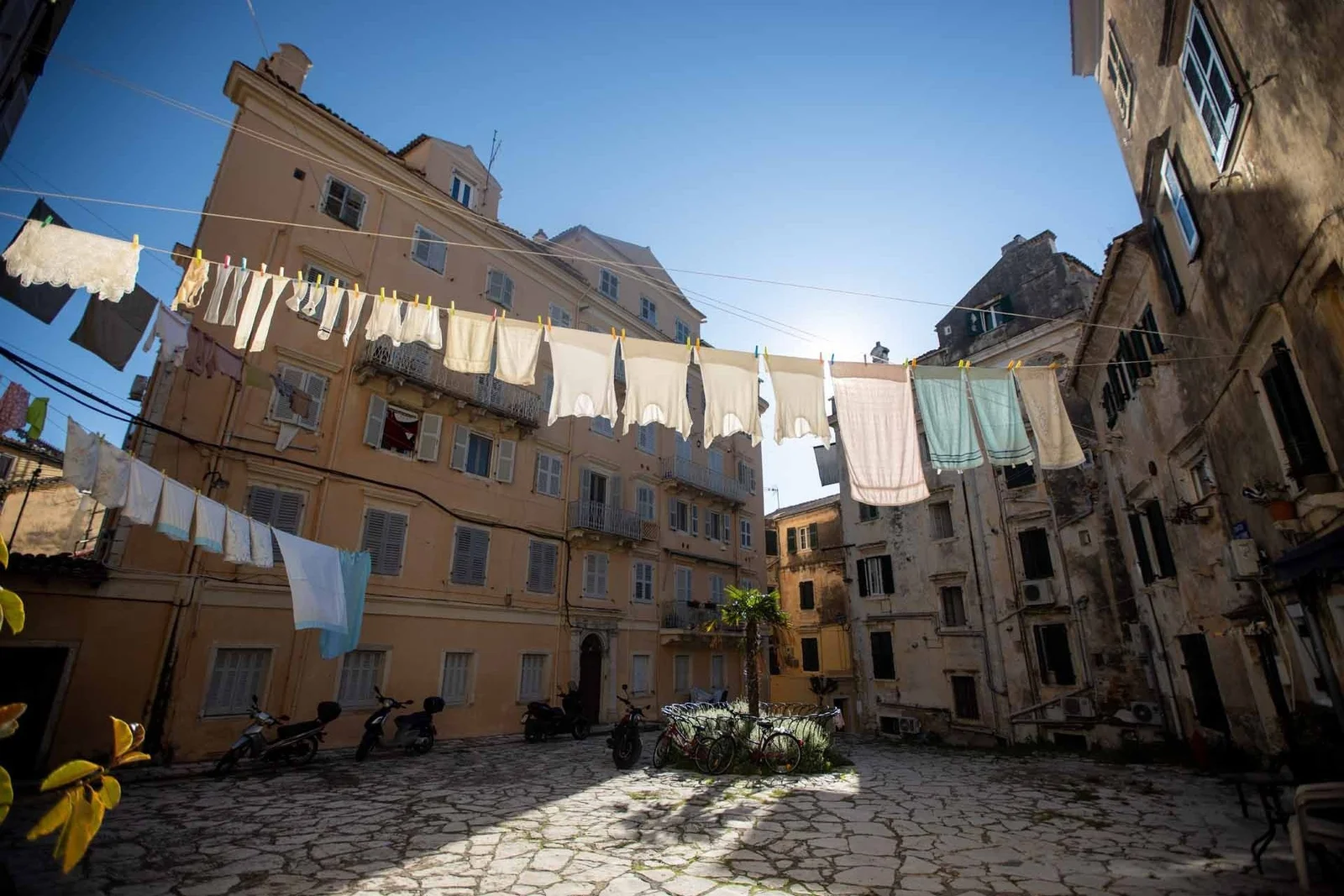
Quick answer: to live in Greece rather than visit it, a non-EU national needs a residence permit, because visa-free presence is capped at 90 days in any rolling 180-day period across the whole Schengen area. The permit routes divide by income source: pension, remote employment, independent means, or investment through the Golden Visa. Two preferential tax regimes are worth checking before you move, the 7 percent flat rate for foreign pensioners and the €100,000 non-dom charge for high foreign incomes. Property comes after the permit question, not before it.
Most guides to living in Greece are written as a list of pleasant things followed by a list of mild complaints. That is not useless, but it answers a question nobody has. The people who actually move here are deciding between countries, and they need to know which permit they qualify for, what it costs them in tax, and which parts of the system will take longer than they expect.
This page is the structural version. Where a number is statutory it is cited to the law that sets it.
The 90-day ceiling, and why it is the starting point
A non-EU national may be present in the Schengen area for 90 days in any rolling 180-day period without a residence permit, under Article 6 of the Schengen Borders Code. Three things about that rule catch people out.
It is area-wide, not country-wide. Days in Portugal, Italy or Croatia count against the same 90. Buying a house in Greece does not create a separate Greek allowance.
It is rolling, not annual. The window moves with you, so the calculation is not “90 days per calendar year” and cannot be reset by flying home for a weekend.
It is a ceiling on visits, not a status. You cannot be resident in Greece on it, cannot become tax resident through it, and cannot use it as a bridge while an application is pending. The how long you can stay guide works through how the count interacts with a residence permit once you hold one.
Everything else on this page assumes you intend to exceed that ceiling, which means a permit.
Which permit, by what funds you
Greece does not have one immigration route. It has several, and they sort by where your money comes from rather than by where you want to live.
| If your income is | The route is | What it turns on |
|---|---|---|
| A foreign pension | Financially independent person, often with the 7% tax election | Proven regular pension income and health cover |
| Remote work for a non-Greek employer | Digital nomad visa and permit | Employment or client contracts outside Greece, plus an income floor |
| Savings and investments, no employment | Financially independent person | Demonstrable passive income and health cover |
| A property purchase | Golden Visa | The investment threshold for the location |
| A Greek employer | Work permit | A job offer and a quota position |
The Golden Visa is the route this site covers in most depth, and it is also the route most often chosen for the wrong reason. It is an investment permit: it grants residence without requiring you to live in Greece, which suits someone who wants optionality. If your intention is actually to move, the pension and independent-means routes are usually cheaper and involve no property purchase at all. The Golden Visa hub sets out the thresholds; the point here is that buying a house is one route among several rather than the default.
The two tax regimes worth checking before you move
Greek tax residence generally follows presence, and crossing 183 days in a year brings worldwide income into scope. Two special regimes change that arithmetic, and both have to be elected rather than granted automatically.
The 7 percent pensioner regime. Article 5B of Law 4172/2013 lets a foreign pensioner who transfers tax residence to Greece elect a flat 7 percent rate on worldwide income for a fixed period. What makes it notable is the scope: it covers foreign-source income generally, not the pension alone. Conditions attach to prior non-residence and to the source country, so it is checked against your own position. The 7 percent pension regime guide sets out the eligibility test.
The non-dom regime. Article 5A charges a flat €100,000 a year on foreign-source income, regardless of the size of that income, and entry requires an investment of at least €500,000 in Greek real estate, a business or securities. The flat charge is the whole point: above a certain income it is dramatically cheaper than the ordinary scale, and below that income it is dramatically worse. The non-dom guide shows where the crossover sits.
| Regime | Charge | Entry condition |
|---|---|---|
| Article 5B, foreign pensioners | 7% flat on worldwide income | Transfer of tax residence, prior non-residence, qualifying pension |
| Article 5A, non-domiciled | €100,000 flat on foreign income | Investment of at least €500,000 in Greece |
| Ordinary Greek residence | Progressive scale on worldwide income | Default position past 183 days |
Neither regime is a reason to move. Both are reasons to time a move carefully, and to take the tax advice before the removal quote rather than after.
If you let a property while you are here
The rental income scale changed on 1 January 2026 under Law 5246/2025, and it changed in a way that matters most to the middle of the range.
| Annual gross rent | Rate from 2026 |
|---|---|
| Up to €12,000 | 15% |
| €12,001 to €24,000 | 25% |
| €24,001 to €35,000 | 35% |
| Above €35,000 | 45% |
The 25 percent band is new, and income that previously sat in a lower band moved into it. The other feature that surprises foreign landlords is the deduction: an individual may set only a flat 5 percent for repairs and maintenance against gross rent. There is no deduction for management, insurance, travel or the mortgage. The charge therefore falls on something close to the gross figure rather than on profit, which is why yield projections built on net-of-costs assumptions overstate the result. The rental income guide works through the filing mechanics for a non-resident owner.
One further restriction applies if the property is also a Golden Visa asset: it may only be let on a lease of twelve months or longer, and short-term tourist letting is prohibited. That rule binds the property, not the owner, so it survives a change of plans.
Where foreigners actually settle, and how the three choices differ
Almost every foreign resident ends up in one of three places, and the difference between them is not scenery. It is how much of the year the place operates at full capacity, and how much administration you can do without leaving town.
| Athens and the Riviera | Crete | The Ionian islands | |
|---|---|---|---|
| Year-round operation | Full, all services open | Full in the cities, seasonal in the villages | Seasonal outside the main towns |
| Administration on the spot | Every office, ministries included | Regional offices in Heraklion and Chania | Limited, often a ferry away |
| International schooling | Several established options | Limited, concentrated in the cities | Effectively none |
| Healthcare depth | Full hospital network, private and public | Regional hospitals in the two main cities | Local clinics, referrals off-island |
| Who it tends to suit | Working residents, families, anyone needing the bureaucracy nearby | People who want island character with a mainland service level | Second-home owners and retirees who accept the winter |
Athens is the practical answer for anyone still working, raising children, or dealing with a permit application that will need several visits to the same building. The Riviera suburbs give a coastal life inside a functioning city, which is a combination the islands cannot offer.
Crete is the compromise that works most often. It is large enough to carry two proper cities with hospitals and regional government, and it runs through the winter rather than closing, while still being an island. That is why it absorbs more long-term foreign residents than any other Greek island.
The Ionian islands, Corfu and Kefalonia in particular, are where the second-home and retirement demand concentrates, and they carry the sharpest seasonal difference. The summer version and the February version of Corfu are close to different places. That suits people who came for the quiet and frustrates people who came for the summer they remembered.
None of these is better. They fail for different reasons, and knowing which failure you can tolerate is more useful than a ranking.
What the pros-and-cons lists get right
The advantages that appear on every list are real and are not worth restating at length. Climate, coastline, food, a slower default pace, a genuinely low crime rate in most places people actually settle, and a healthcare system that works better than its reputation once you are inside it.
Two are worth adding because they rarely appear:
Distance. Greece is a three to four hour flight from most of Western Europe and a direct long-haul from the eastern United States in summer. For anyone keeping ties to another country, the flight map does more for quality of life than any single local amenity.
Optionality inside the country. The gap between Athens and a small island is not just scenery, it is a different life with different costs and a different amount of administration. Few countries of this size let you change your mind that completely without changing your paperwork.
What they get wrong, or leave out
The administration is the hard part, and it does not stop. The tax number, the residence permit, the social security registration, the utility transfers and the periodic bank compliance reviews each run on separate timetables and none of them shares information with the others. Foreign residents who settle well are the ones who treated this as a fixed cost of the move and paid an accountant, rather than the ones who expected it to get easier after year one.
Island life and mainland life are different products. Winter on a small island means a reduced ferry timetable, some services closed, and a much smaller pool of tradespeople. That is a feature for some people and a reason to leave for others, and it is not visible on an August viewing trip. Anyone considering an island should see it in February before committing.
Banking is slower than you expect. Opening an account as a non-resident is a compliance exercise rather than a formality, and it recurs: accounts get reviewed and documents get requested again. Build it into timetables rather than treating it as a one-off.
Tax residence arrives whether you plan for it or not. Crossing 183 days makes you Greek tax resident, and that is a status with consequences for worldwide income, reporting and sometimes for the tax treatment of assets in your home country. The people who get hurt are not the ones who chose the wrong regime, they are the ones who did not realise they had chosen at all.
Where to go next
The three questions people ask after this one, in the order they usually ask them: what it costs to live here month to month, how the move itself is sequenced, and whether buying is better than renting for the first year.
If you are weighing a purchase alongside the move, the Greece property investment guide covers the market side, and citizenship after a Golden Visa covers where the residence route eventually leads for those who want it to lead somewhere.
Frequently Asked Questions
Ninety days in any rolling 180-day period, and the count applies across the whole Schengen area rather than to Greece alone, under Article 6 of the Schengen Borders Code. Days spent in Spain, Italy or any other Schengen state consume the same allowance. Owning property in Greece does not create an additional entitlement. Anyone intending to live in Greece rather than visit needs a residence permit, and choosing the permit route is the first decision in the move.
It follows your income source rather than your preference. A foreign pension points to the financially independent person route, often combined with the 7 percent tax election. Remote work for a non-Greek employer points to the digital nomad route. Savings and investment income with no employment point to the independent means route. A property purchase at the qualifying threshold points to the Golden Visa, which grants residence without requiring you to live in Greece. A Greek job offer points to a work permit.
Article 5B of Law 4172/2013 allows a foreign pensioner who transfers tax residence to Greece to elect a flat 7 percent rate on worldwide income for a fixed number of years. The scope is what distinguishes it: it covers foreign-source income generally rather than ring-fencing the pension. Eligibility turns on prior non-residence and on the country paying the pension, so it needs checking against your own circumstances before the move rather than after arrival.
Only above a high foreign income. Article 5A charges a flat €100,000 a year on foreign-source income irrespective of its size, and entry requires an investment of at least €500,000 in Greek real estate, a business or securities. Because the charge is flat, it becomes cheaper than the ordinary progressive scale only once foreign income is large enough that the ordinary charge would exceed €100,000. Below that point the ordinary scale costs less.
Under the scale in force from 1 January 2026 an individual landlord pays 15 percent on the first €12,000 of gross rent, 25 percent from €12,001 to €24,000, 35 percent from €24,001 to €35,000, and 45 percent above €35,000. The 25 percent band was introduced for 2026. Only a flat 5 percent deduction for repairs and maintenance may be set against gross rent, with no deduction for management, insurance or finance costs, so the tax falls on close to the gross figure.
The volume and persistence of administration. The tax number, residence permit, social security registration, utility transfers and recurring bank compliance reviews each run on separate timetables and none shares information with the others, so the same documents get produced repeatedly. It does not resolve after the first year. Foreign residents who settle comfortably tend to be the ones who budgeted for an accountant from the start rather than treating the paperwork as a temporary phase.
Substantially, and it is the single thing most often missed by buyers who view in August. Smaller islands run reduced ferry timetables in winter, a share of restaurants and services close for the season, and the pool of available tradespeople shrinks. For some residents that quiet is the point. For others it is the reason they leave after two years. Anyone considering a small island should visit in February before committing to a purchase.
Next steps: the 7 percent pension regime · the non-dom regime · the Golden Visa hub.
Practical guides

Cost of Living in Greece 2026: What Official Data Shows
Eurostat puts Greece 14% below the EU average, but food above it. Where the saving is real, how Greece compares to Portugal, and what the index cannot say.

Moving to Greece 2026: Visas, Tax Timing, First 90 Days
The move sequenced against two clocks: the 90-day Schengen ceiling and the 183-day tax residence trigger, with the UK and US positions set out separately.
Read next
Greece 7% Pension Tax: The Flat Regime for Retirees
Greece taxes relocating foreign pensioners at a flat 7% on all foreign income for 15 years under Article 5B: conditions, deadlines, worked numbers, pitfalls.
Greece Non-Dom Tax Regime: The €100K Flat Rate (5A)
Greece's Article 5A non-dom regime: €100,000 flat tax on all foreign income for 15 years, €500,000 investment test, €20,000 per family member. Full guide.
How Long Can You Stay in Greece on the Golden Visa?
Greece Golden Visa has zero minimum stay for renewal under Law 5100/2024. Schengen travel, bridging docs, 183-day tax risk, and family rules explained.

Greece Rental Income Tax 2026: Non-Resident Rates Guide
Progressive 15 to 45% Greek rental income tax for non-residents: brackets, filing steps, deductible expenses, AFM setup, and Golden Visa STR restrictions.
Greece Citizenship After Golden Visa: The 7-Year Path
Can a Greece Golden Visa lead to citizenship? The 7-year naturalisation path, physical presence rules, language requirement, and the EU passport outcome.

Greece Property Investment Guide 2026: Yields & Data
Greece property investment 2026: 41,743 transfers worth €4.2B, +7.5% price growth, Athens yields to 5.43%, Golden Visa tiers and the Ellinikon regen.
Get your Greece property shortlist
Share your budget, region (Athens, Crete, islands, or Peloponnese), and Golden Visa goal. We reply within one business day with matched options and next steps.