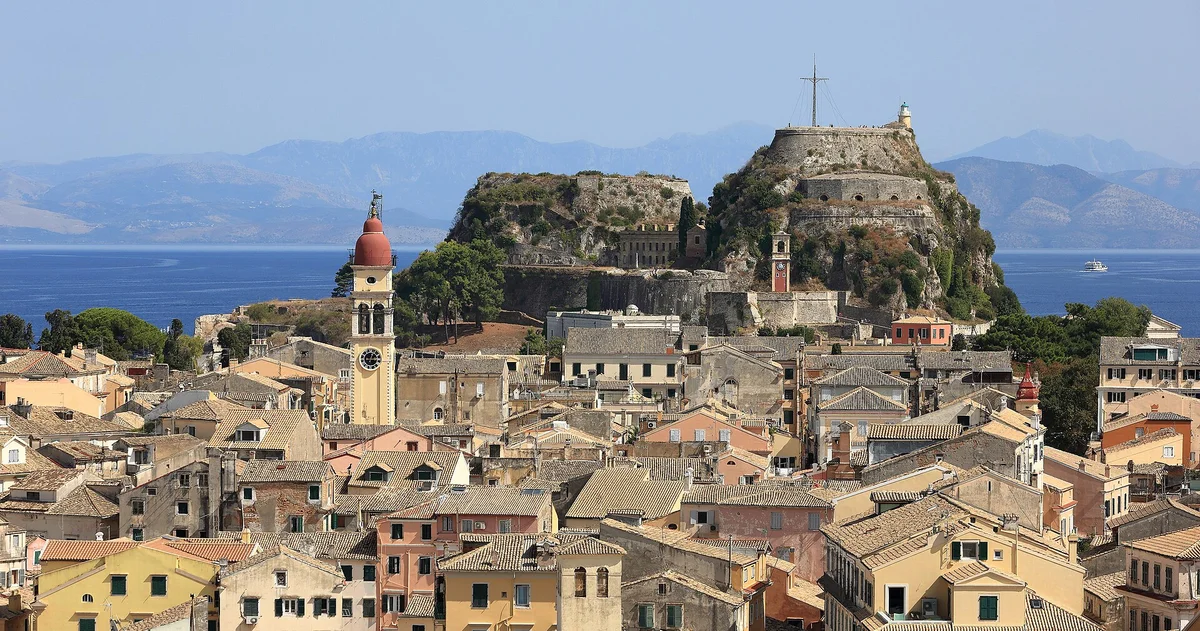
Quick answer: Corfu asks about €2,932 per square metre in the main municipality on June 2026 listing data, rising to about €4,698 in the Kassiopi area and about €5,628 in the municipality of Paxoi within the wider prefecture. It is the most expensive Ionian island, and the reason is the age and depth of its international market rather than anything about the coastline. It falls in the €400,000 Golden Visa tier, with the area rule rather than the price binding on the expensive north-east coast.
What the island asks
| Where | Asking price per m² | Source and reference |
|---|---|---|
| Paxoi, within Corfu Prefecture | about €5,628 | Indomio, June 2026 |
| Kassiopi, north-east coast | about €4,698 | Indomio, July 2026 |
| Municipality of Corfu | about €2,932 | Indomio, June 2026 |
All are asking prices from Indomio listings rather than recorded transactions; the market overview sets out why that distinction matters on thin markets.
Against its neighbours, Corfu tops the Ionian. It sits above Zakynthos at about €2,889 and comfortably above Kefalonia at a little under €2,400, while remaining far below Mykonos at about €7,623.
The premium is a hundred and fifty years old
Corfu is not more beautiful than Kefalonia, and its beaches are not better than Lefkada’s. What it has that neither has is a foreign property market with genuine history.
The British connection runs to the nineteenth century and the Ionian State, and the modern version has been building since package flights began. The consequence is a large stock of foreign-owned property, agents who have sold to international buyers for generations, and northern European flights across a long season.
That produces three things a newer market does not have.
Depth of demand. More buyers looking at any moment, which supports price and shortens time on market.
A real resale market. You are not the only person who might ever want the house. On the thinner Ionian islands that is a genuine question; here it is not.
Established professional infrastructure. Lawyers, engineers, agents and builders who have dealt with foreign buyers repeatedly and know what the process requires.
The price is what that maturity costs. A buyer choosing Corfu over Kefalonia is paying roughly a fifth more per square metre for a deeper, more liquid market, and whether that is worth it depends entirely on how long they intend to hold.
Where on the island, and why the north-east costs what it does
The north-east coast, roughly Kassiopi through Kalami to Agni and Nissaki. Steep green hillsides dropping to small bays, looking across a narrow strait to Albania. It has carried British ownership for so long that it acquired a nickname, and it is both the most expensive part of Corfu at about €4,698 per square metre and the most liquid at resale.
Corfu Town and the centre. The Venetian old town, a UNESCO site, plus the surrounding municipality at about €2,932 per square metre. Year-round services, the airport, the port, and the part of the island that functions in February.
The west coast. Bigger beaches, more package tourism in places, more wind, and prices below the north-east.
The south and the interior. Olive groves, villages, less international recognition, and where the same budget buys substantially more. The part of Corfu that most resembles Kefalonia in price and in feel.
The pattern that repeats across Greece applies here too, with one difference: on Corfu the premium area is premium because of who has been buying there for fifty years, not because of the airport. Everywhere else on the Ionian, airlift explains the price map. Here, history does.
Golden Visa: the area rule binds first on the north-east
Corfu sits in the €400,000 tier, since it is not named in the prime zone under Law 5100/2024 and falls below the population threshold.
The complication is arithmetic rather than legal. A qualifying property needs at least 120 square metres of main usable area, certified by a Greek engineer. At Kassiopi prices near €4,698 per square metre, €400,000 corresponds to roughly 85 square metres, which is below the threshold. In the municipality of Corfu at about €2,932 the same sum corresponds to roughly 136 square metres, which clears it.
So a Golden Visa buyer on Corfu has a real choice to make: buy in the centre or the south where €400,000 produces a qualifying property, or buy on the north-east coast and budget meaningfully above the tier minimum. This is the same trap that appears on Lefkada, and it catches people who read the tier and stopped there. The tier guide sets out the zones, and the Corfu Golden Visa guide covers the island-specific detail.
The letting restriction applies as everywhere: twelve-month leases only for a qualifying property, for the life of the permit.
What the portals will not tell you
Search results for Corfu property are held by Rightmove, A Place in the Sun, Zoopla and the Greek portals, all with live inventory. This page is not trying to compete with a database, and a buyer looking for listings should use them.
What none of them provides is the part that decides whether a purchase works: what the island costs by area, why the north-east carries a premium and whether that premium holds at resale, which Golden Visa tier applies and where the area rule bites, and what old Corfiot stock hides.
That is a division of labour rather than a competition. Use the portals for inventory and this for the decisions the inventory does not answer.
Old stock, and what it hides
Corfu has more historic building than most Greek islands, and the buildings are the reason people fall for it. They are also where the money goes.
Venetian and British-era town houses. Thick stone walls that hold damp, structural timber of unknown age, and roofs that have been patched rather than replaced across generations. The engineer’s inspection is doing real structural work here, not just checking permits.
Generational additions. A house extended repeatedly over a century frequently has work that was never permitted. The engineer cannot certify it, and without the certificate the notary cannot complete. On old island stock this is the single most common reason a sale stalls.
The UNESCO old town. Corfu Town’s old quarter carries alteration controls on materials, appearance and structure that go beyond ordinary planning rules. Establish what may be changed on a specific building before an offer.
Boundaries in olive country. Rural plots often carry boundaries that were historically informal. The cadastre check is where that surfaces.
The full due diligence sequence covers each search and the document that closes it.
Liquidity is the thing you are actually buying
Every other island page on this site talks about the buyer pool as a risk. On Corfu it is worth reframing as the product, because it is the only Greek island where a foreign owner can reasonably assume there will be a market when they want out.
The mechanism is simple and it compounds. A long-established foreign market means agents who list internationally as a matter of course, buyers who arrive already knowing the island, and comparable sales to price against. Each of those makes the next transaction easier, which is why depth persists once a market has it and why a newer island struggles to acquire it however good the coastline.
For a buyer the practical readings are three.
Time on market is shorter. A correctly priced Corfu house sells in a normal period rather than waiting for the one person who wanted that specific island.
Pricing is more knowable. With more transactions there are more comparables, so a valuation is a judgement rather than a guess. On the thinnest islands there may be two relevant sales in a year.
The downside is shallower. A market with several independent sources of demand does not fall as far when one of them pauses.
None of that argues that Corfu is the better buy. It argues that the premium over Kefalonia is purchasing something specific, and that a buyer who does not care about resale is paying for a feature they will not use.
What a budget buys
| Budget | Municipality of Corfu, €2,932/m² | Kassiopi, €4,698/m² |
|---|---|---|
| €250,000 | about 85 m² | about 53 m² |
| €400,000 | about 136 m² | about 85 m² |
| €600,000 | about 205 m² | about 128 m² |
Acquisition costs come off buying power first, and the cost stack sets out what they consist of. On old stock, budget renovation separately and generously: the discount for condition on a Corfiot town house is frequently smaller than the cost of curing it, which is the reverse of the situation on cheaper islands.
Buyer scenarios
A buyer with €400,000 taking a Golden Visa file. Works comfortably in the municipality of Corfu or the south, where that sum clears the 120 square metre rule. Does not work in Kassiopi without going well above the threshold. Decide which side of that line you are on before shortlisting.
A buyer wanting the north-east coast. Budget above the tier minimum if a permit is involved, expect a mature market with real competition, and treat the premium as buying liquidity rather than buying scenery. Resale here is the easiest on the Ionian.
A buyer comparing Corfu with Kefalonia. Roughly a fifth more per square metre for a materially deeper buyer pool, better professional infrastructure and easier exit. Worth it for a shorter hold or if resale matters; less obviously worth it for someone buying a house to keep.
Risks and red flags
Reading the tier without the area rule. €400,000 does not produce a qualifying property on the expensive coast.
Underestimating old stock. Structural timber, damp and unpermitted generational additions are the three that cost money, and only the third stops a sale outright. The first two simply arrive later, as a bill.
Assuming the north-east premium is transferable. It attaches to that coast, not to the island. A house in the south is priced by the southern market, and a seller who paid a north-east price for a southern house is carrying that difference themselves.
UNESCO constraints in the old town. Real, specific to the building, and not negotiable. They are also the reason the old town looks the way it does, so a buyer attracted by that appearance is buying into the rules that produced it rather than around them.
Buying on a portal listing alone. Inventory is what portals do well. Condition, legality and area certification are not in the listing, and on an island where a large share of stock predates any modern permit regime that gap is where the risk lives.
Assuming the long British presence means British standards. It means a deeper market and better-informed agents. It does not mean a survey has been done, a permit exists, or that the previous foreign owner checked any of it before you.
Frequently Asked Questions
The municipality of Corfu averaged about €2,932 per square metre in June 2026, while the Kassiopi area in the north-east asked about €4,698 in July 2026 and the municipality of Paxoi within the wider prefecture about €5,628. These are asking prices from Indomio listings rather than recorded transactions. Corfu is the most expensive Ionian island, above Zakynthos at about €2,889 and Kefalonia at a little under €2,400, though well below Mykonos at about €7,623.
Market maturity rather than landscape quality. Corfu has carried an international buying market for well over a century, with a British connection running to the nineteenth century, flights from across northern Europe over a long season and a large stock of foreign-owned property. That produces a deeper buyer pool, more transactions, a real resale market and established professional infrastructure. The price reflects the depth of demand rather than a coastline its neighbours match.
The €400,000 tier, since Corfu is not named in the prime zone under Law 5100/2024 and falls below the population threshold. The complication is the area rule rather than the price: a qualifying property needs at least 120 square metres of main usable area, and at Kassiopi prices near €4,698 per square metre €400,000 buys only about 85 square metres. In the municipality of Corfu at about €2,932 the same sum buys roughly 136 square metres and clears the threshold.
The north-east coast between Kassiopi, Kalami, Agni and Nissaki, which has carried British and northern European ownership long enough to acquire its own nickname. It is the most expensive part of the island at about €4,698 per square metre and the most liquid at resale. Corfu Town and the surrounding municipality are considerably cheaper at about €2,932, and the south and interior cheaper still with far less international recognition.
Both, for different things. Rightmove, A Place in the Sun, Zoopla and the Greek portals hold the listings and a content site cannot compete with live inventory. What none of them tells you is what the island costs by area, why the north-east premium exists and whether it holds at resale, which Golden Visa tier applies and where the area rule bites, or what old Corfiot stock hides. Use portals for inventory and this for the decisions.
Four things. Structural timber and damp in thick stone walls, which the engineer's inspection addresses as real structural work rather than a formality. Generational additions built without permits, which the engineer cannot certify and which stop a notary completing. UNESCO alteration controls if the property is in Corfu Town's old quarter. And boundaries on rural olive-country plots, which were historically informal and surface in the cadastre check.
It depends on the hold period and on whether resale matters. Corfu costs roughly a fifth more per square metre than Kefalonia and buys a materially deeper buyer pool, better professional infrastructure and an easier exit. For a shorter hold, or for anyone who wants to know that someone else will want the house, that is worth paying. For a buyer intending to keep a house indefinitely, the cheaper islands offer the same landscape for less.
Next steps: the wider Greek market · Kefalonia, the cheaper Ionian option · comparing the islands.
Read next
Greece Golden Visa Property Tiers 2026: €800K vs €400K
Law 5100/2024 created three Greece Golden Visa tiers. Compare €800K prime zones, €400K regional, and €250K conversion thresholds to pick the right investment.
Due Diligence Greece Property: The Complete 2026 Checklist
Due diligence Greece property: title search, cadastre, ENFIA arrears, permits, engineer survey, co-ownership, mortgages, Golden Visa tier. Full checklist.
12 Hidden Costs Buying Property in Greece: 2026 List
The real total for a Greek purchase: transfer tax 3.09%, notary, lawyer and agent fees plus 12 costs buyers miss, with a worked example on a €400K purchase.
Greece Property Cadastre Check: Verify Title Before You Buy
Greece property cadastre check: Ktimatologio lookup, unknown owner status, forest registry overlap, lawyer extracts, red flags, registration timelines.
Corfu Golden Visa Property Investment Guide for 2026
Corfu qualifies at the €400K Golden Visa tier. Ionian prices, 120m² rule, border zones, yields and where foreigners buy in 2026.
Get your Greece property shortlist
Share your budget, region (Athens, Crete, islands, or Peloponnese), and Golden Visa goal. We reply within one business day with matched options and next steps.