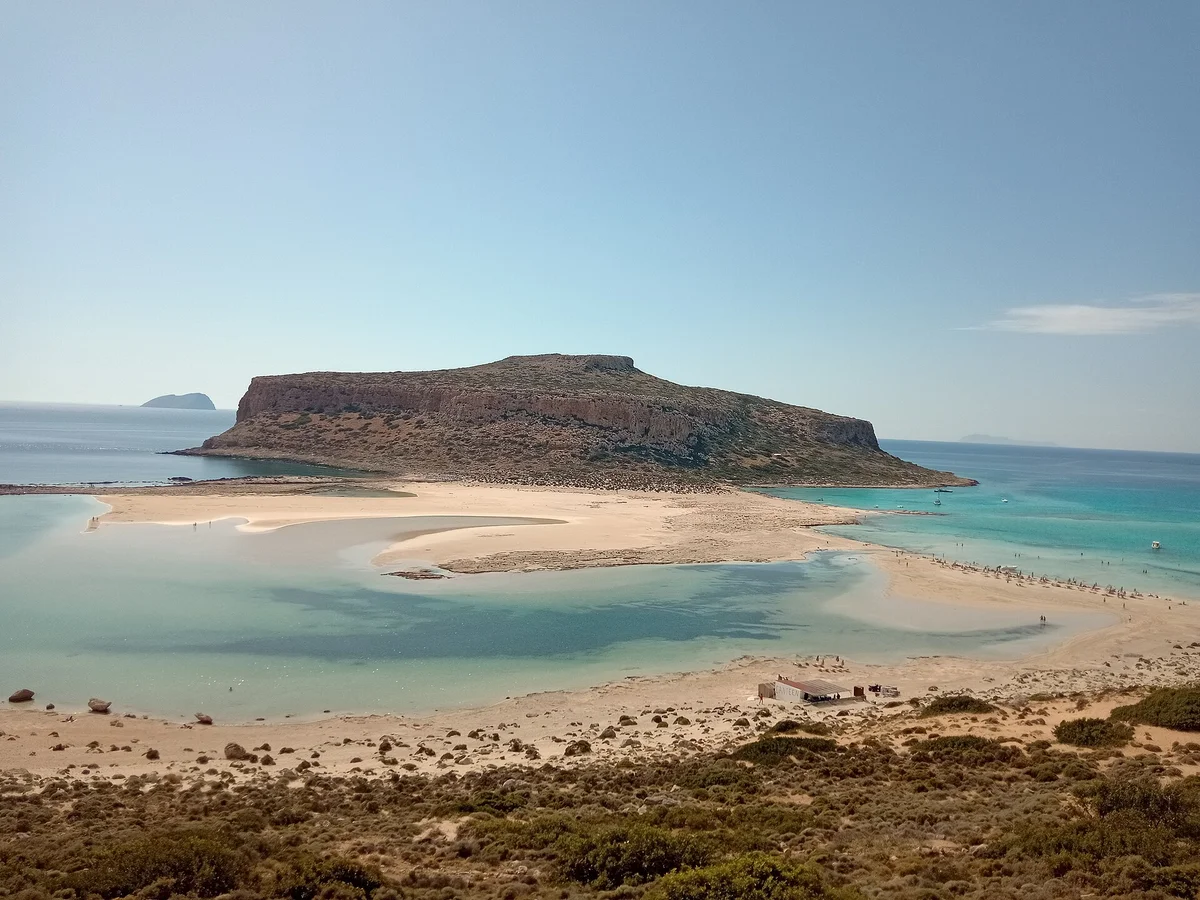
Quick answer: Crete averaged about €2,329 per square metre in April 2025, up 12.5% in a year, ranging from about €1,999 in Heraklion Prefecture to about €2,935 in Chania Prefecture, with the town of Chania itself near €3,690. The island falls in the €400,000 Golden Visa tier, where the average price clears the 120 square metre area rule comfortably. What separates Crete from every other Greek island is scale: it is large enough to function as a region rather than as a destination.
What the island asks
| Where | Asking price per m² | Source and reference |
|---|---|---|
| Chania town | about €3,690 | Indomio, August 2026 |
| Chania Prefecture | about €2,935 | Indomio, August 2025 |
| Crete, island average | about €2,329 | Indomio, April 2025 |
| Heraklion Prefecture | about €1,999 | Indomio, August 2025 |
Asking prices across Crete rose 12.5% year on year to April 2025. As everywhere on this site these are asking prices from Indomio listings rather than recorded transactions, and the market overview sets out why that distinction matters.
Against the alternatives, Crete sits close to Rhodes at about €2,421 and below Corfu at about €2,932 in its main municipality. It is more expensive than the Peloponnese at about €1,778 and a third of Mykonos at €7,623.
The only island large enough to be a region
Crete is not a bigger version of a Greek island. It is a different kind of place, and that is the argument for it.
It carries two cities. Chania and Heraklion both have hospitals, universities, courts, year-round commerce and airports with winter service. It has an agricultural economy, olive oil and wine and produce, that exists independently of tourism and employs people through the year. It has mountains that hold snow, a south coast with a different climate from the north, and a permanent population large enough that the island does not empty in October.
Resort strips empty as they do everywhere. The island does not, and the difference between those two statements is the whole case.
The practical consequences are the same four that make Rhodes work, at greater scale: works can happen in winter, resale is not confined to a summer window, healthcare is on the island rather than a flight away, and a real long-let market exists alongside the holiday one.
That is why Crete absorbs more long-term foreign residents than any other Greek island, and why it appears on almost every shortlist that starts with “somewhere we could actually live”.
The yield calculation, and its limits
Crete is the only Greek island in this research where both halves of a yield calculation are published in the same place for the same period, so it is worth doing carefully and then stating what it is not.
For Chania Prefecture in August 2025, asking rent was about €9.79 per square metre per month against an asking price of about €2,935 per square metre.
| Step | Figure |
|---|---|
| Monthly asking rent per m² | €9.79 |
| Annualised | about €117 |
| Asking price per m² | €2,935 |
| Implied gross yield | about 4.0% |
Three caveats, and they matter more than the number.
It is asking-on-asking. Neither figure is a transaction. Sellers and landlords both start high, and the two errors do not necessarily cancel.
It is gross. The Greek rental income scale reaches 45% from 2026 with only a flat 5% deduction for repairs against gross rent, so the net figure is considerably lower. The rental income guide sets out the bands.
It assumes full-year letting. On a property let seasonally the annualisation does not hold.
With those attached, 4.0% is a sane order of magnitude. It sits below the Athens average of 5.43% and near the national 4.40%, which is what a large island with a functioning long-let market should look like: better than a seasonal island, worse than a capital city.
Asking rent in Lasithi Prefecture was about €6.93 per square metre per month over the same period, the lowest on the island. The corresponding price figure is not published, so no equivalent yield can be calculated honestly, and this page does not estimate one.
The prefectures are four different markets
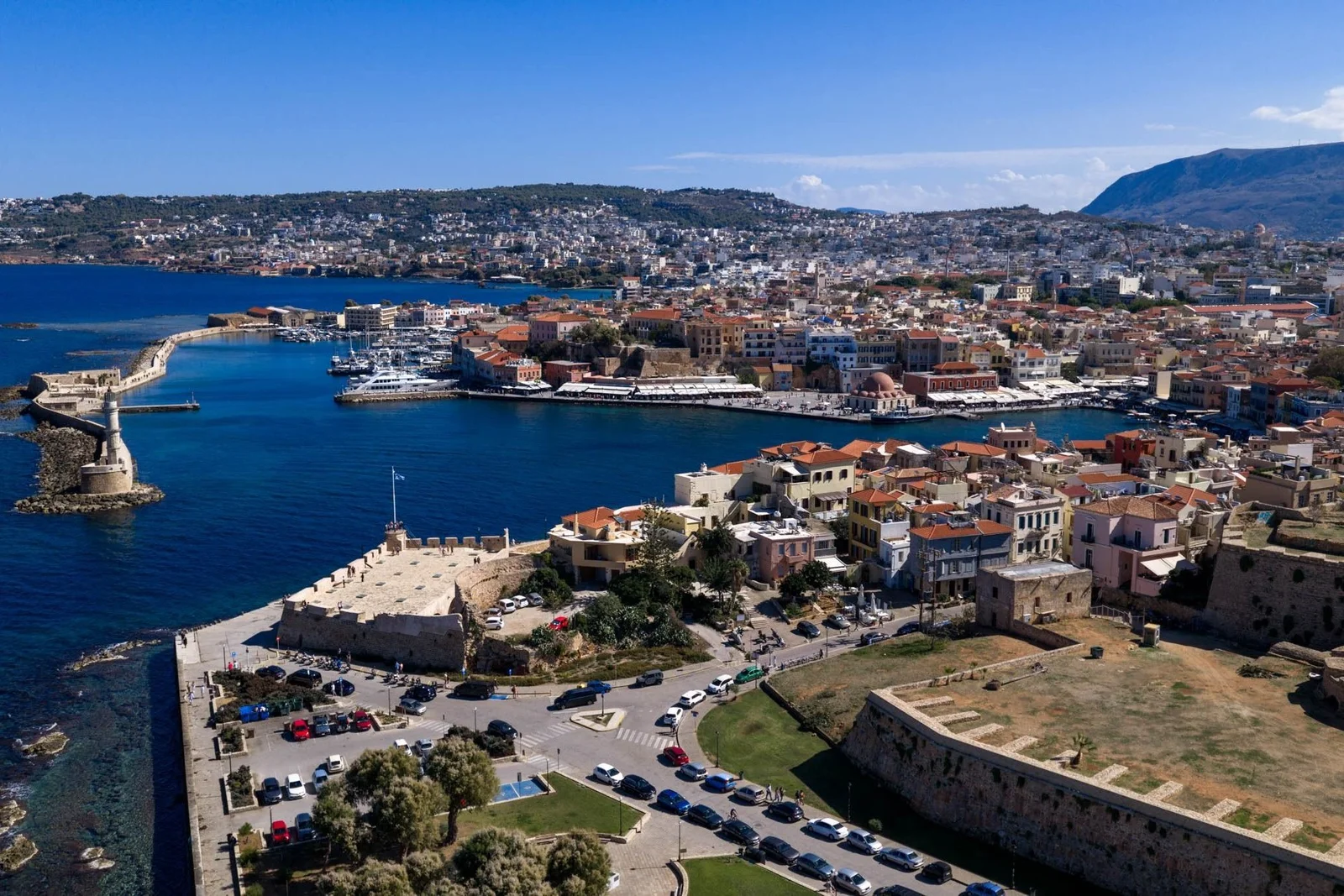
Chania, the west. The most expensive, the prettiest, the most internationally known, and where most foreign buying concentrates. The Venetian harbour town is the image people have of Crete. Prefecture asking prices near €2,935 and the town itself near €3,690.
Rethymno, between them. A smaller Venetian town, a long beach, and prices between Chania and Heraklion. Less foreign competition than Chania and more character than Heraklion.
Heraklion, the centre and the island’s commercial capital. The cheapest prefecture at about €1,999 and the most working-city in character. Knossos, the main port, the biggest airport. Overlooked by foreign buyers precisely because it is a city doing a job rather than a postcard.
Lasithi, the east. Agios Nikolaos and Elounda at the top end, quieter agricultural country behind, and the lowest asking rents on the island.
The spread between Chania town and Heraklion Prefecture is nearly two to one, and they are ninety minutes apart on a national road.
North coast and south coast are different climates
Almost every price figure quoted for Crete describes the north. That is where the two cities, both airports, the main port and nearly all the foreign buying sit, along the national road that runs the length of the island.
The south is a separate proposition. The White Mountains and the Psiloritis range cut the island in half, and the south coast beyond them is hotter, drier, less built and reached by mountain roads rather than by the national road. Places like Plakias, Paleochora and Ierapetra are an hour or more over a pass from the north, and in winter those passes see snow. Prices are lower, the light is different, and the practical question is not the view but whether a specialist appointment, a builder or a delivery will make the journey.
Buyers who fall for the south usually do so on a summer visit and underestimate the drive. Buyers who want the south for what it is, quieter and warmer and further from everything, get a genuinely different island for less money. Both are reasonable; they are just not the same purchase, and a price per square metre quoted for the island does not distinguish between them.
The distances are real distances
Crete runs about 260 kilometres end to end, and that changes how a purchase works compared with any other island on this site.
Two international airports, Heraklion and Chania, both with winter service, sit about 140 kilometres apart. A property in Lasithi in the east is roughly three hours by road from Chania in the west. The lawyer, the notary, the engineer and the tax office are organised by prefecture, so a purchase in one part of the island is not administered from another.
The practical consequence is that “Crete” is not a search area. Choosing a prefecture comes before choosing a property, because it determines which airport visitors use, which hospital is nearest, which professionals handle the file, and how long the drive is when something needs attending to. On a small island none of that is a decision. Here it is the first one.
Golden Visa: comfortable, except in Chania town
Crete sits in the €400,000 tier throughout, since it is outside Attica and is not named in the prime zone under Law 5100/2024.
At the island average near €2,329 per square metre, €400,000 corresponds to roughly 172 square metres, which clears the 120 square metre main usable area requirement with room. In Heraklion Prefecture at about €1,999 it corresponds to roughly 200 square metres, more comfortably still.
In the town of Chania at about €3,690, the same €400,000 corresponds to roughly 108 square metres, which does not clear the threshold. So the same trap that appears on Lefkada and on Corfu’s north-east coast applies to Crete’s most expensive town, and only there.
The tier guide sets out the zones. The tier follows the cadastral parcel rather than the island’s name, and the letting restriction applies as everywhere: twelve-month leases only on a qualifying property.
What the portals will not answer
Search results for Crete property belong to Rightmove, A Place in the Sun, Spitogatos and the Cretan agencies, all with live inventory. This page is not competing with a database and a buyer looking for listings should use them.
What none of them addresses is which prefecture suits which buyer, why Chania costs nearly twice Heraklion, whether the 12.5% rise is a trend or a listing-mix artefact, what the yield arithmetic actually supports, or where the Golden Visa area rule bites on this island. Those are the decisions, and the inventory does not contain them.
What to check on Crete specifically
The standard due diligence sequence applies, with three local emphases.
Building legality on rural stone stock. Extensions and enclosed terraces built across generations are common inland, and the engineer’s certificate is what stops a sale completing without them being resolved.
Water on the south coast and inland. Crete is drier than the Ionian, and water supply on rural plots is a real question rather than an assumption.
Archaeology. Dense across the island, particularly around Heraklion, and capable of constraining a plot or halting works.
What a budget buys
| Budget | Heraklion, €1,999/m² | Island average, €2,329/m² | Chania town, €3,690/m² |
|---|---|---|---|
| €200,000 | about 100 m² | about 86 m² | about 54 m² |
| €400,000 | about 200 m² | about 172 m² | about 108 m² |
| €600,000 | about 300 m² | about 258 m² | about 163 m² |
Acquisition costs come off buying power first, and the cost stack itemises them.
Buyer scenarios
A buyer who wants to actually live in Greece. Crete is the strongest answer among the islands, because the services, the healthcare and the year-round economy exist at scale. Chania for character, Heraklion or Rethymno for value.
A buyer with €400,000 taking a Golden Visa file. Comfortable across most of the island, where that sum clears the area rule with room. Not comfortable in Chania town itself, where it buys about 108 square metres against a 120 square metre requirement.
A buyer looking for yield. Crete is the island where the arithmetic can at least be checked, at roughly 4.0% gross on asking figures in Chania Prefecture. Heraklion should do better on the same logic, being cheaper. Neither beats Athens at 5.43%, and both are gross rather than net.
Risks and red flags
Projecting the 12.5% forward. It measures asking prices over one twelve-month window and is not a return.
Reading the island as one market. Chania town is nearly twice Heraklion Prefecture, ninety minutes apart.
Treating the 4.0% as a net yield. It is gross, asking-on-asking, and assumes year-round letting.
Assuming the €400,000 tier is enough everywhere. In Chania town the area rule binds first.
Underestimating water and legality inland. The two rural questions that most often turn a cheap Cretan house into an expensive one.
Frequently Asked Questions
The island averaged about €2,329 per square metre in April 2025, up 12.5% year on year. By prefecture, Chania was highest at about €2,935 and Heraklion lowest at about €1,999 in August 2025, while the town of Chania itself asked about €3,690 in August 2026. These are asking prices from Indomio listings rather than recorded transactions. Crete sits close to Rhodes at about €2,421, below Corfu, and well above the Peloponnese at about €1,778.
On asking figures for Chania Prefecture in August 2025, rent of about €9.79 per square metre per month against a price of about €2,935 per square metre implies a gross yield near 4.0%. Three caveats matter more than the number: it is asking-on-asking rather than transaction-based, it is gross while the Greek rental scale reaches 45% from 2026 with only a flat 5% deduction, and it assumes year-round letting. As an order of magnitude it is reasonable.
The €400,000 tier across the island, since Crete is outside Attica and not named in the prime zone under Law 5100/2024. At the island average near €2,329 per square metre that sum corresponds to roughly 172 square metres and clears the 120 square metre area requirement comfortably, and in Heraklion Prefecture near €1,999 it buys about 200 square metres. In Chania town at about €3,690 it buys only about 108 square metres, so the area rule binds there.
Better than any other Greek island. It carries two cities in Chania and Heraklion with hospitals, universities, courts and year-round commerce, airports with winter service, and an agricultural economy of olive oil, wine and produce that employs people independently of tourism. Resort strips empty in winter as everywhere, but the island itself does not, which is why Crete absorbs more long-term foreign residents than anywhere else in the Greek islands.
Chania is more expensive, prettier and where foreign buying concentrates, with the prefecture asking about €2,935 per square metre and the town about €3,690. Heraklion is the island's commercial capital and its cheapest prefecture at about €1,999, with a working-city character and far less foreign competition. Chania buys character and liquidity; Heraklion buys roughly twice the floor area and, on the same rent logic, better yields. Rethymno sits between them on both.
Partly, and the figure needs reading carefully. It covers the twelve months to April 2025 and measures asking prices rather than transactions, so some of it is what sellers request rather than what buyers pay. Crete also has demand support that most Greek islands lack: a year-round economy, growing long-term foreign residence and international airlift through the winter. Both readings are consistent with the data, and neither makes a past rise a forecast.
Three things beyond the standard searches. Building legality on stone stock, where extensions and enclosed terraces built across generations are common inland and where the engineer's certificate is what allows a notary to complete. Water supply, since Crete is drier than the Ionian and rural plots cannot be assumed to have it. And archaeological constraints, which are dense across the island, particularly around Heraklion, and can restrict a plot or halt works.
Next steps: the wider Greek market · comparing the islands · the Golden Visa tiers.
Read next
Greece Golden Visa Property Tiers 2026: €800K vs €400K
Law 5100/2024 created three Greece Golden Visa tiers. Compare €800K prime zones, €400K regional, and €250K conversion thresholds to pick the right investment.
Due Diligence Greece Property: The Complete 2026 Checklist
Due diligence Greece property: title search, cadastre, ENFIA arrears, permits, engineer survey, co-ownership, mortgages, Golden Visa tier. Full checklist.
Greece Rental Income Tax 2026: Non-Resident Rates Guide
Progressive 15 to 45% Greek rental income tax for non-residents: brackets, filing steps, deductible expenses, AFM setup, and Golden Visa STR restrictions.
12 Hidden Costs Buying Property in Greece: 2026 List
The real total for a Greek purchase: transfer tax 3.09%, notary, lawyer and agent fees plus 12 costs buyers miss, with a worked example on a €400K purchase.
Crete Property Investment Guide 2026: Island Markets
Crete property investment 2026: €400K Golden Visa tier, ~€2,329/m² average, what the yield data supports, north coast markets, GV vs Attica arbitrage.
Get your Greece property shortlist
Share your budget, region (Athens, Crete, islands, or Peloponnese), and Golden Visa goal. We reply within one business day with matched options and next steps.