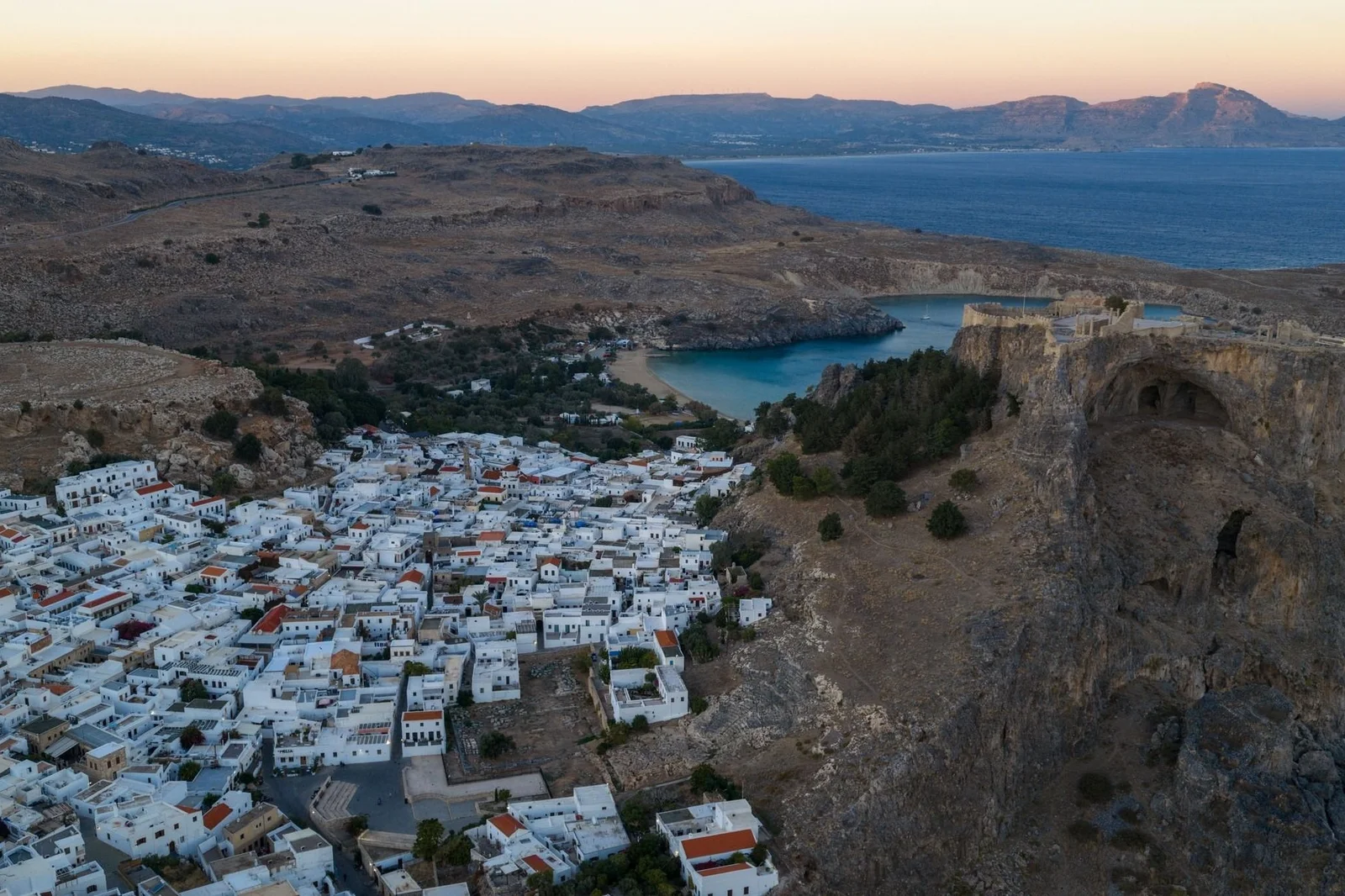
Quick answer: Rhodes asks about €2,421 per square metre on January 2026 listing data, up 22.40% in a year, ranging from roughly €1,453 in Archaggelos to €3,339 in Lindos. That is around a third of Mykonos and broadly comparable with the Ionian islands. What separates Rhodes from both is scale: it is large enough to carry a city, a hospital and a year-round economy, which changes what owning here means. It falls in the €800,000 Golden Visa tier because of its population, unlike the smaller Dodecanese islands around it.
What the island asks
| Where | Asking price per m² | Source and reference |
|---|---|---|
| Lindos | about €3,339 | Indomio, January 2026 |
| Dodecanese region average | about €2,438 | Indomio, November 2025 |
| Rhodes island average | about €2,421 | Indomio, January 2026 |
| Archaggelos | about €1,453 | Indomio, January 2026 |
Asking prices on Rhodes rose 22.40% year on year to January 2026, and the wider Dodecanese rose 20.87% to November 2025. Both are asking prices from live listings rather than recorded transactions, which the market overview explains at length.
Two readings of a rise that size are both defensible. Rhodes has drawn increased foreign attention and has more year-round viability than comparable islands, which supports real demand. And on a market of this scale, a change in what gets listed moves the average without anything happening to prices actually paid. The figure is a signal that the market is active rather than a return anyone should project forward.
Against the neighbours, Rhodes sits close to Zakynthos at €2,889 and above Kefalonia at a little under €2,400, and at roughly a third of Mykonos at €7,623.
The island that keeps working after October
This is the argument for Rhodes and it is not a small one.
Rhodes Town carries a permanent population in the tens of thousands, a general hospital, courts, a university presence, year-round shops and an airport that runs through the winter with domestic and some international service. The resort strips along the coast empty out, as they do everywhere, but the island itself does not shut.
For an owner that changes four things that matter more than they sound.
Works can happen in winter. Trades are on the island year-round, so a renovation timetable is set by the scope rather than by who is available in February.
A property can be viewed and sold in any month. Resale is not confined to a summer window, which is a real constraint on smaller islands.
Healthcare is on the island. For older buyers and for anyone considering more than a few weeks a year, this is frequently the deciding factor rather than a footnote.
Long letting is possible. There is a resident rental market, which means a property can earn outside the tourist season rather than sitting empty.
Very few Greek islands offer that combination. Crete does, at greater scale. Corfu does, partially. Most of the Aegean does not.
Where on the island, and what each part is for
Rhodes Town and the northern tip. The year-round island. Services, the port, the airport within reach, and the medieval city. The most expensive part outside Lindos and the part that behaves least like a resort.
Lindos and the east coast. The postcard Rhodes, and at about €3,339 per square metre the most expensive area on the island. Strong letting demand, heavily seasonal, and a village with strict controls on what may be built or altered.
The west coast. Windier, cooler, less developed, with the beaches that suit watersports rather than swimming. Prices below the island average and a different kind of buyer.
The interior and the south, including Archaggelos. Where the €1,453 end of the range lives. Villages, agriculture, distance from the airport, and the part of the island most overlooked from abroad. The money goes furthest here and the resale pool is smallest.
The pattern is the one that repeats across Greek islands: price tracks proximity to the airport and to the letting market, not the quality of the place.
The old town is a different legal environment
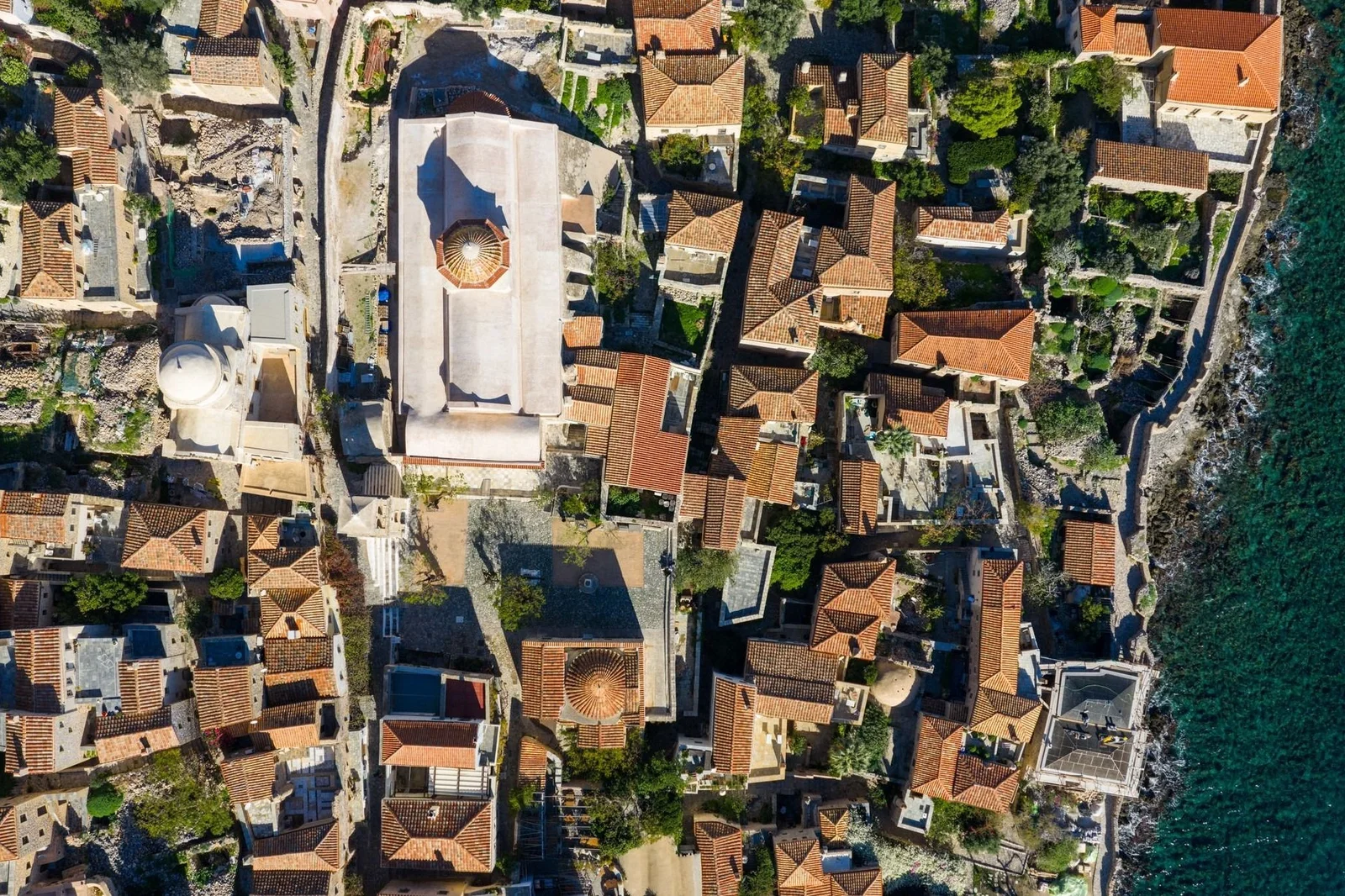
The walled medieval city of Rhodes is a UNESCO World Heritage site and one of the most tightly controlled property environments in the country.
Buying there brings constraints that go well beyond ordinary planning rules: restrictions on alteration, on materials, on external appearance and on anything that touches the fabric of a protected building. Works may require approvals from heritage authorities, and excavation can uncover archaeology that stops a project entirely while it is assessed.
None of that makes it a bad purchase. Buildings inside the walls are genuinely rare assets and behave accordingly. It does mean that anyone considering one should establish the specific constraints on the specific building before an offer rather than after, because “we will open this up and put in a bathroom” is a sentence that can turn out to be impossible.
Golden Visa: Rhodes is prime zone, its neighbours are not
Rhodes sits above the population threshold that places an island in the €800,000 tier under Law 5100/2024. The smaller Dodecanese islands nearby, Symi, Karpathos, Patmos and the rest, fall in the €400,000 tier.
That produces a sharp discontinuity across a short ferry ride. A qualifying purchase on Rhodes needs €800,000 in a single property with at least 120 square metres of main usable area; the same buyer on a neighbouring island needs half that. Given Rhodes asking prices near €2,421 per square metre, €800,000 corresponds to roughly 330 square metres, which is a large house rather than a typical one.
The practical effect is that Golden Visa buyers on Rhodes concentrate in the higher end of the market by necessity. The tier structure sets out the zones, and the 120 square metre rule covers the area test that comes with both higher tiers. As always the tier follows the cadastral parcel rather than the island’s name.
The Dodecanese around it
Rhodes is the entry point to an archipelago that most buyers never look past, and the neighbours are a genuinely different proposition rather than smaller versions of the same thing.
Symi is a single spectacular harbour of neoclassical houses stacked up two hillsides, an hour from Rhodes by ferry, with a tiny year-round population and a season that is short even by Aegean standards. Property there is bought by people who wanted Symi specifically, and it resells to the same narrow group.
Karpathos is long, mountainous and windy, with a strong emigrant diaspora that owns much of the housing stock and a culture that has stayed unusually intact. It is harder to reach than Rhodes and priced accordingly.
Patmos carries a monastery that is a UNESCO site and a quiet, expensive market disproportionate to its size, sustained by a small number of buyers who return.
Kos is the other Dodecanese island with an international airport and mass tourism, which makes it the closest structural comparison to Rhodes, at a smaller scale and with less year-round depth.
All of these sit in the €400,000 Golden Visa tier rather than Rhodes’s €800,000 one, which is the single most consequential fact about the archipelago for anyone combining a purchase with a residence application. A buyer priced out of a qualifying purchase on Rhodes may find the same budget qualifies comfortably an hour away, at the cost of everything the larger island offers in services and connections.
What a budget buys here
At the island average of about €2,421 per square metre, a €300,000 budget corresponds to roughly 124 square metres of built area before costs. At Archaggelos prices near €1,453 the same budget corresponds to about 206 square metres, and in Lindos at about €3,339 to about 90.
Two adjustments apply as everywhere. Acquisition costs come off buying power first, and the cost stack sets out what they consist of. And condition, land and outbuildings move a real property well away from any average in both directions.
The third adjustment is specific to Rhodes and worth stating: the island is large enough that location within it changes the practical value of a property more than the price difference suggests. A house forty minutes from the airport and a house ninety minutes from it are different assets even at the same price per square metre, because one gets used more and sells faster.
What to check on Rhodes specifically
The standard due diligence sequence applies, with three local emphases.
Heritage and archaeological constraints, not only inside the old town. Rhodes has archaeology across the island, and a plot can carry restrictions that a listing does not mention.
Building legality on older stock. The engineer’s certificate does the usual work, and enclosed terraces and additions are as common here as elsewhere.
The cadastre entry against what is on the ground. The cadastre check matters on an island where plot boundaries in villages are often old and informally understood.
Buyer scenarios
A buyer with €250,000 wanting a year-round house. Achievable inland or in the south, where the budget corresponds to roughly 172 square metres at Archaggelos prices. The trade is distance from the airport and a smaller resale pool. Not a Golden Visa file, so letting stays unrestricted.
A buyer with €800,000 taking a Golden Visa file. The €800,000 tier applies, and at island average prices that corresponds to about 330 square metres, so the qualifying property is at the large end of the market. Lindos or the northern coast are where that money buys something that makes sense as a house rather than as a threshold.
A retiree considering an island with a hospital. Rhodes is one of the few Greek islands where that combination exists at this price level, and the healthcare argument is usually what decides between it and a cheaper Aegean alternative. The wider Greek market compares the regional options on service levels rather than on price alone.
Risks and red flags
Projecting the 22.40% forward. It describes asking prices in one twelve-month window on a market where listing mix moves averages.
Assuming the €400,000 tier because it is not Mykonos. Rhodes is prime zone. The neighbouring islands are not, and the difference is €400,000.
Buying inside the walls without establishing what may be altered. Heritage constraints are real, specific to the building, and not negotiable.
Treating the resort coast as the island. The strips empty in winter even though the island does not, and an August viewing on the east coast does not describe February anywhere.
Underestimating distance. Rhodes is large. The drive from the southern villages to the airport is a serious journey, and it affects both use and resale.
Buying a resort-strip apartment as a year-round asset. The two things this page separates, the island working in winter and the coast emptying in winter, are not the same claim. A block built for package holidays in a resort that closes is a seasonal asset on a year-round island, and it behaves like the former.
Frequently Asked Questions
Asking prices averaged about €2,421 per square metre in January 2026, up 22.40% year on year, with Lindos most expensive at about €3,339 and Archaggelos cheapest at about €1,453. The wider Dodecanese averaged about €2,438 in November 2025, up 20.87%. These are asking prices from Indomio listings rather than recorded transactions, so the growth rates describe what sellers are asking rather than what buyers actually paid.
Better than almost any Greek island of its size. Rhodes Town carries a permanent population in the tens of thousands, a general hospital, courts, a university presence and an airport running through the winter. The coastal resort strips empty out as they do everywhere, but the island itself does not close. For an owner that means works can happen in winter, a property can be viewed and sold in any month, healthcare is on the island, and long letting to residents is possible.
The €800,000 prime zone tier, because Rhodes sits above the population threshold set by Law 5100/2024. The smaller Dodecanese islands nearby, including Symi, Karpathos and Patmos, fall in the €400,000 tier, so the threshold halves across a short ferry ride. At Rhodes asking prices near €2,421 per square metre, €800,000 corresponds to roughly 330 square metres, which places qualifying purchases at the large end of the island's market.
Yes, and it is among the most tightly controlled property environments in Greece. The walled city is a UNESCO World Heritage site, which brings restrictions on alteration, materials, external appearance and anything affecting the fabric of a protected building, plus archaeological considerations that can halt works. Buildings inside the walls are genuinely rare assets, but the specific constraints on the specific building should be established before an offer rather than after.
Two explanations both fit and the data does not separate them. Rhodes has drawn increased foreign attention and has more year-round viability than comparable islands, which supports genuine demand. And on a market of this size a shift in the mix of what is listed moves the average without prices paid changing. Since the figure measures asking prices rather than transactions, treat 22.40% as evidence the market is active rather than as a return to project forward.
Substantially. Rhodes averages about €2,421 per square metre against roughly €7,623 on Mykonos and €4,363 to €5,742 on Santorini. Rhodes is far larger than either, has a real year-round economy and a longer season, and offers a different kind of island entirely. What it lacks is the international brand recognition and direct long-haul airlift that set Cycladic prices, and that recognition is essentially the whole of the price difference.
It follows what the property is for. Rhodes Town and the northern tip give year-round services and the medieval city, at the highest prices outside Lindos. Lindos and the east coast at about €3,339 per square metre give the strongest letting demand and the heaviest seasonality. The west coast is windier, less developed and below the island average. The interior and south, down toward €1,453 in Archaggelos, give the most space per euro and the smallest resale pool.
Next steps: the wider Greek market · the Golden Visa tiers · the due diligence sequence.
Read next
Greece Golden Visa Property Tiers 2026: €800K vs €400K
Law 5100/2024 created three Greece Golden Visa tiers. Compare €800K prime zones, €400K regional, and €250K conversion thresholds to pick the right investment.
Due Diligence Greece Property: The Complete 2026 Checklist
Due diligence Greece property: title search, cadastre, ENFIA arrears, permits, engineer survey, co-ownership, mortgages, Golden Visa tier. Full checklist.
12 Hidden Costs Buying Property in Greece: 2026 List
The real total for a Greek purchase: transfer tax 3.09%, notary, lawyer and agent fees plus 12 costs buyers miss, with a worked example on a €400K purchase.
Greece Property Cadastre Check: Verify Title Before You Buy
Greece property cadastre check: Ktimatologio lookup, unknown owner status, forest registry overlap, lawyer extracts, red flags, registration timelines.
Golden Visa 120 m² Rule Greece 2026: Single Deed Only
Balconies and parking do not count. How engineers certify main usable area for €400K and €800K tiers, common deed mistakes, and the €250K heritage exemption.
Get your Greece property shortlist
Share your budget, region (Athens, Crete, islands, or Peloponnese), and Golden Visa goal. We reply within one business day with matched options and next steps.