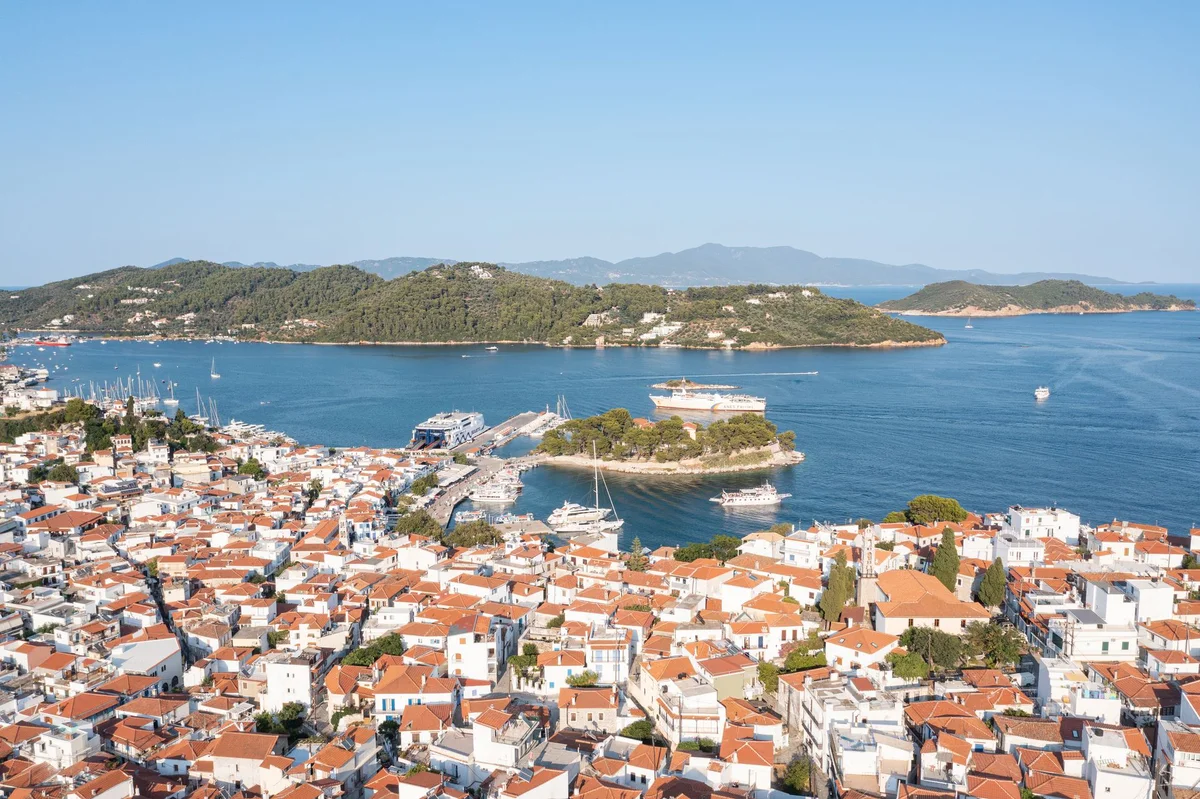
Quick answer: there is no reliable published price per square metre for Skiathos, and anyone quoting one is quoting a luxury listing aggregator rather than a market index. What can be established is the shape of the place: an unusually small island with an international airport, a short and intense season, a quiet winter, the €400,000 Golden Visa tier, and a neighbouring island in Skopelos that offers the same landscape without the flights or the crowds.
Why this page has no price table
Every other regional page on this site opens with a table: a figure, a source, a reference month. Kefalonia, Zakynthos, Rhodes, Lefkada, the Peloponnese and Athens all have one, because a portal index publishes them.
Skiathos does not appear in that dataset. What does appear in search results are figures from luxury listing aggregators, which sample a handful of high-end villas and produce averages in the seven figures. Those numbers are real in the sense that somebody is asking them, and useless as a description of a market, because the sample is not the market.
Publishing one anyway would look more authoritative than this section does and would be considerably less true. So the honest position is: nobody publishes a defensible Skiathos average, this page will not invent one, and what follows is what can actually be established.
If you need a number for a specific purchase, the source is local listings for comparable properties in the specific part of the island, read by somebody who knows what has actually sold. That is a smaller and more useful claim than an island average.
What can be offered instead is the neighbourhood the island sits in. These are measured markets with published indices, and Skiathos sits somewhere among them rather than outside them.
| Measured comparison | Asking price per m² | Source and reference |
|---|---|---|
| Lefkada, Apollonio | about €4,910 | Indomio, June 2026 |
| Zakynthos, province | about €2,889 | Indomio, October 2025 |
| Rhodes, island average | about €2,421 | Indomio, January 2026 |
| Kefalonia, island average | under €2,400 | Indomio, June 2026 |
| Peloponnese, region | about €1,778 | Indomio, March 2026 |
Skiathos is smaller than every island in that table, more seasonal than most of them, and better connected by air than all but Rhodes. Where those three pull against each other is exactly why a single average would be misleading even if one existed.
What can be established: the airport
Skiathos is small and has an international airport, which for an island of this size is genuinely unusual and is the single most important fact about its property market.
Direct summer charter and scheduled flights from the UK and northern Europe have run for decades. The runway is short and the approach is well known to anyone who follows aviation. The practical effect for a property owner is the one that matters: guests and owners arrive on one flight rather than a flight plus a ferry, and the buyer pool at resale includes anyone who can book a direct seat.
Compare that with Kefalonia, which is larger and has an airport with thinner international service, or with Skopelos next door, which has none. On the islands, airlift is the variable that most reliably separates a market that functions from one that does not, and Skiathos punches far above its size on it.
The corollary is dependence. A market built on direct summer flights is a market exposed to the airlines that operate them, in a way that a large island with a year-round economy is not.
The Sporades around it
Skopelos is half an hour away by ferry, greener and more heavily forested, with no airport, far less development and a market that is thinner in both directions. It is where people who want the Sporades without the Skiathos summer end up, and the trade is a smaller resale pool.
Alonissos is quieter again, with a marine park offshore and correspondingly little development. A place bought by people who wanted Alonissos.
Skyros, further out and administratively separate from the others, is barely a market at all in the sense a foreign buyer would recognise.
| Island | Airport | Development | Golden Visa tier |
|---|---|---|---|
| Skiathos | International, direct summer flights | Developed tourism economy | €400,000 |
| Skopelos | None, ferry only | Light, heavily forested | €400,000 |
| Alonissos | None, ferry only | Minimal, marine park offshore | €400,000 |
| Skyros | Small, limited service | Barely a foreign market | €400,000 |
All four sit in the €400,000 Golden Visa tier alongside Skiathos, so the tier is not what differentiates them. Access is, and the table above is really a table about flights.
The season, and the winter
Skiathos runs on a summer that is roughly May to early October, with the strong weeks narrower still. Flights, ferries and most businesses follow that curve.
Winter is quiet even by Greek island standards. The permanent population is small, services reduce, and a substantial share of what makes the island attractive in August is closed. That is not a criticism of the place, it is a description of a small island with a tourism economy, and it applies to most of the Aegean.
What it means for a buyer is the same instruction that appears on every island page here, and it is repeated because people keep not doing it: see the island in February before you commit. The August version sells itself. The February version is the one you would own.
Golden Visa position
Skiathos, Skopelos and Alonissos all fall in the €400,000 tier rather than the €800,000 prime zone, since none is named in Law 5100/2024 and none passes the population threshold.
A qualifying purchase is a single residential property at or above €400,000 on one title deed with at least 120 square metres of main usable area, certified by a Greek engineer rather than taken from a listing. The tier guide sets out the zones.
The restriction that follows matters here for the same reason it matters across the Aegean: a qualifying property may only be let on leases of twelve months or longer, and short-term letting is prohibited for the life of the permit. On an island whose entire income case is a ten-week summer, that removes the income case rather than reducing it. The letting restriction guide covers what renewal checks.
What to check on Skiathos specifically
The standard due diligence sequence applies, with three emphases that follow from the island being small, wooded and steep.
Forestry designation. Skiathos and Skopelos are heavily forested, and land classified as forest carries building restrictions that are strict and not visible from the ground. This is the most common complication in the Sporades.
Access and terrain. Steep sites are common, and a plot with a view may not have vehicle access to the door. That affects building costs, servicing and eventual resale.
Building legality. The engineer’s certificate does the usual work, and on older island stock enclosed terraces and additions are common. The cadastre check covers boundaries, which on small wooded islands are frequently old and informally understood.
What the missing data actually tells you
The absence of a published index for Skiathos is itself informative, and worth reading rather than lamenting.
Portal indices exist where there is enough listing volume to average. Kefalonia, Zakynthos, Rhodes and the Peloponnese all clear that bar. Skiathos does not, which means the number of properties on the market at any moment is small.
Three consequences follow for a buyer, and none of them appears in a listing.
Individual transactions move the market. On a thin market a single ambitious sale resets what nearby sellers ask, and a single motivated one resets what buyers expect. Neither is a trend, and both will be presented as one.
Comparables are scarce. Valuing a property here means finding genuinely similar recent sales, and on a small island there may be two rather than twenty. That makes local knowledge worth more than anywhere with a functioning index, and it makes a confident valuation from a distance worth less.
Exit takes longer. The same shortage of listings that prevents an index reflects a shortage of transactions, which is the condition you meet when selling. A property that suits a narrow buyer waits for that buyer.
None of this argues against buying on a small island. It argues for buying something you would be content to hold, and for treating any confident market projection about Skiathos with the scepticism the underlying data deserves.
The competition here is the weakest in Greece
Worth stating plainly, because it is unusual. The search results for Skiathos property are held by one single-office website, four portals running their generic island template, a Facebook group and a listings aggregator.
Not one of them tells a prospective buyer what the island costs, how it compares to anywhere else, what the tier is, what forestry designation means or what happens in February. The information gap here is wider than on any island of comparable demand, which is a statement about the incumbents rather than about the island.
That gap is why this page exists in the form it does. It cannot close the price question, because the data is not there. It can close every other question a buyer has, which is more than any current alternative does.
What is knowable and what is not
Being explicit about the boundary is more useful than pretending it is not there.
| Question | Answerable here | Why |
|---|---|---|
| What does the island cost per m² | No | No published index covers it |
| How does it compare to measured islands | Yes | Their indices are published |
| Which Golden Visa tier applies | Yes | Set by statute and population |
| Can I let it short-term | Yes | Set by statute, and by permit status |
| What is the season | Yes | Observable and consistent |
| What restricts building | Yes | Forestry, terrain and legality, all checkable |
| What will a specific house sell for | No | That is a valuation, not a page |
The pattern is that everything set by law, geography or observation can be answered, and everything that requires a market measurement cannot. That is not a limitation of this page so much as a description of what data exists about small Greek islands, and it applies equally to every competitor quoting a confident figure.
Buyer scenarios
A buyer wanting a summer house with direct flights. This is Skiathos’s case and it is a strong one. Few Greek islands of this size let guests arrive without a connection. Budget for a short, intense season and a quiet winter, and price the property on whether you want it rather than on projected occupancy.
A buyer wanting the Sporades without the crowds. Skopelos, at the cost of a ferry transfer and a thinner resale market. Greener, quieter, less built, and bought by people who chose it deliberately.
A buyer taking a €400,000 Golden Visa file. The tier applies across the Sporades and the area rule is the thing to verify, since 120 square metres of certified main usable area is a real constraint on small island stock. The letting restriction removes the summer income model, so the purchase has to stand as a house.
Risks and red flags
Any quoted island average. There isn’t one. Treat a confident figure as a signal about the source rather than about the island.
Forestry classification. The most common Sporades complication, checkable in advance and expensive afterwards.
Airline dependence. A market built on direct summer flights is exposed to the carriers that fly them.
Buying in August. The single most repeated warning on this site, and the one most consistently ignored on small islands.
Assuming Skopelos is cheaper Skiathos. No airport is a different proposition, not a discount.
Frequently Asked Questions
There is no reliable published figure, and this page does not invent one. The portal index covering Kefalonia, Zakynthos, Rhodes, Lefkada and the Peloponnese does not report a Skiathos average, and the numbers circulating in search results come from luxury listing aggregators sampling a handful of high-end villas, which produces seven-figure averages that describe a sample rather than a market. For a specific purchase the source is local comparable listings read by somebody who knows what has actually sold.
The €400,000 tier, along with Skopelos and Alonissos, since none is named in the prime zone under Law 5100/2024 and none passes the population threshold. A qualifying purchase is a single residential property at or above €400,000 on one title deed with at least 120 square metres of main usable area, certified by a Greek engineer rather than taken from a listing. The tier follows the cadastral parcel rather than the island name.
It has carried direct summer charter and scheduled flights from the UK and northern Europe for decades, which is unusual for an island of its size and is the single reason its property market exists in its current form. The runway is short and the approach is well known to aviation enthusiasts. For an owner the effect is that guests and buyers arrive on one flight rather than a flight plus a ferry, which supports both letting demand and resale.
Access, mostly. Skiathos has the airport, the developed tourism economy and the higher prices. Skopelos is half an hour away by ferry, greener and more heavily forested, with no airport, considerably less development and a thinner market in both directions. Buyers who want the Sporades without the Skiathos summer generally choose Skopelos and accept a smaller resale pool in exchange for the quiet.
Quiet even by Greek island standards. The economy runs on a summer of roughly May to early October, with the genuinely strong weeks narrower, and flights, ferries and most businesses follow that curve. The permanent population is small and services reduce accordingly, so a substantial share of what makes the island attractive in August is closed. Visiting in February before committing is the standard advice and it applies here more than most places.
Forestry designation first, since Skiathos and Skopelos are heavily forested and land classified as forest carries strict building restrictions invisible from the ground. Then access and terrain, because steep sites are common and a plot with a view may have no vehicle access to the door, which affects building cost and resale. Then building legality and the cadastre entry, as everywhere in Greece, since enclosed terraces and informal boundaries are common on older island stock.
Because the incumbents have not written any. The search results are held by one single-office website, four portals running a generic island template, a Facebook group and a listings aggregator, and none of them addresses what the island costs relative to anywhere else, what the Golden Visa tier is, what forestry designation means for a plot, or what the island is like outside the season. The information gap is wider here than on any island of comparable demand.
Next steps: the wider Greek market · Kefalonia, where prices are published · the Golden Visa tiers.
Read next
Greece Golden Visa Property Tiers 2026: €800K vs €400K
Law 5100/2024 created three Greece Golden Visa tiers. Compare €800K prime zones, €400K regional, and €250K conversion thresholds to pick the right investment.
Due Diligence Greece Property: The Complete 2026 Checklist
Due diligence Greece property: title search, cadastre, ENFIA arrears, permits, engineer survey, co-ownership, mortgages, Golden Visa tier. Full checklist.
12 Hidden Costs Buying Property in Greece: 2026 List
The real total for a Greek purchase: transfer tax 3.09%, notary, lawyer and agent fees plus 12 costs buyers miss, with a worked example on a €400K purchase.
Greece Property Cadastre Check: Verify Title Before You Buy
Greece property cadastre check: Ktimatologio lookup, unknown owner status, forest registry overlap, lawyer extracts, red flags, registration timelines.
Get your Greece property shortlist
Share your budget, region (Athens, Crete, islands, or Peloponnese), and Golden Visa goal. We reply within one business day with matched options and next steps.